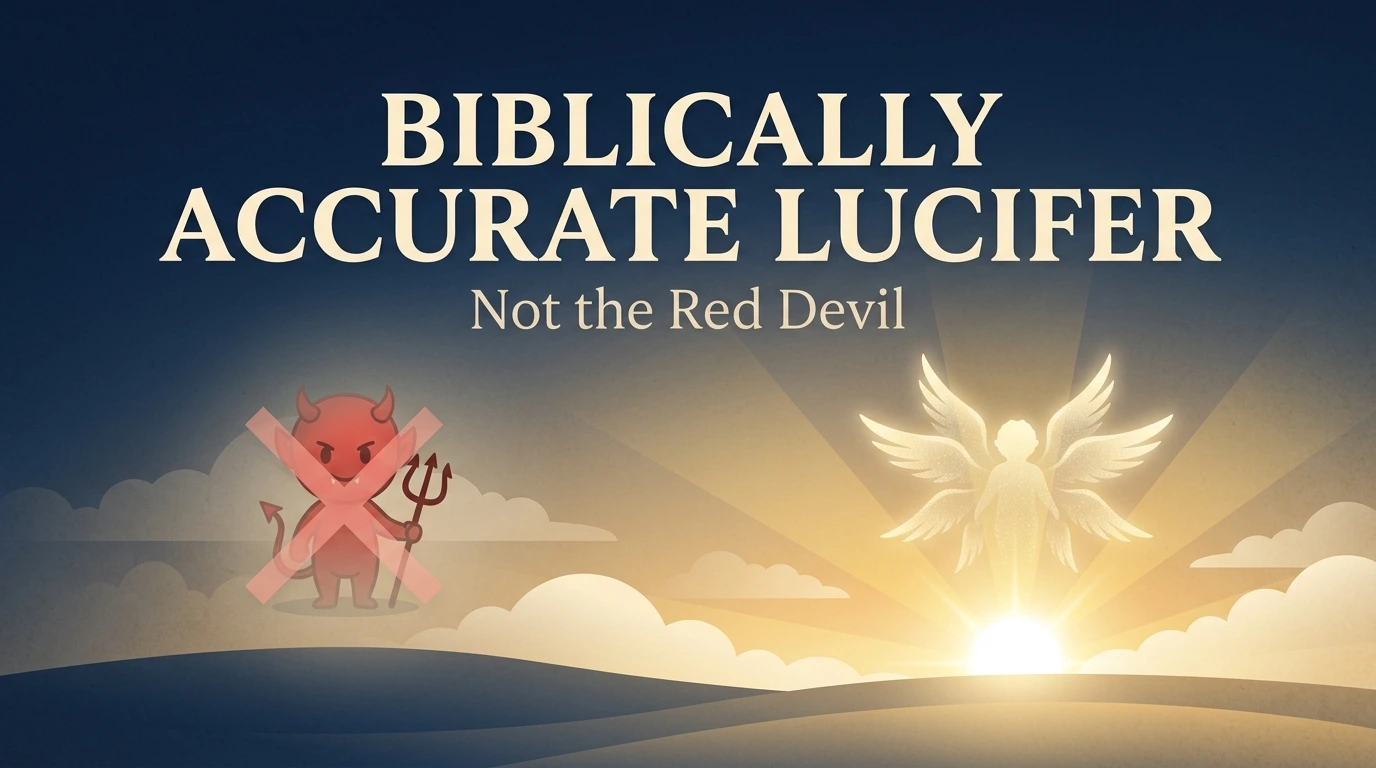
Picture Lucifer and you probably see red skin, horns, and a pitchfork. Open the Bible and that picture is hard to find.
The name appears once in the King James Version, inside a poem mocking the king of Babylon.
Everything else, from the crown of pride to the fall from heaven, has been pieced together from several passages and centuries of tradition. This guide separates what the text states from what readers later added.
You will see the Hebrew behind the name, what Isaiah and Ezekiel describe, how Lucifer became linked with Satan, and what Scripture says about his appearance, his limits, and his end.
Where the Name “Lucifer” Comes From
Most confusion about this topic starts with language. The name “Lucifer” is not Hebrew, and it is not Greek. It is Latin, and it reached English through a chain of translation choices.
The Hebrew Behind the Word
Isaiah 14:12 uses the phrase helel ben-shachar. It is usually understood as “shining one, son of the dawn.” The word helel appears only once in the Hebrew Bible, so there is no second verse to compare it with. Ancient readers would likely have pictured Venus, the morning star that blazes before sunrise and then vanishes as the sun comes up. That image fits a poem about greatness that disappears quickly.
Notice what the Hebrew does not do. It does not present a personal name, and it does not say “Satan.” It is a poetic title inside a taunt.
From Jerome’s Vulgate to the King James Bible
In the late fourth century, Jerome translated the passage into Latin and used lucifer, a common word meaning “light-bearer” that Romans also used for the morning star. It was a reasonable translation. The problem came later, when the Latin word was treated as a name.
The King James Version (1611) kept Lucifer untranslated, so English readers met it capitalized, like a name. Most modern versions, including the NIV, ESV, and NASB, use “morning star,” “day star,” or “shining one” instead. That one translation decision explains why the name feels so biblical even though the Hebrew never used it as a title for an angel.
What Isaiah 14 Actually Says
Isaiah 14 is the passage everyone quotes and few people read from the start. The context changes how the famous verses sound.
A Taunt Against Babylon’s King
Isaiah 14:4 opens by telling the prophet to “take up this taunt against the king of Babylon.” What follows is a victory song over a tyrant who is now dead. The nations that suffered under him watch him arrive in the realm of the dead, and the shades there ask whether this is the man who made the earth tremble.
In ancient Near Eastern writing, kings were often praised in cosmic language, so a falling star was a natural picture of a collapsed ruler. Isaiah turns that habit against the king: the one who claimed the sky is brought down to the pit.
The Five “I Will” Statements
Verses 13 and 14 give the king’s boasts. He says he will ascend to heaven, raise his throne above the stars of God, sit on the mount of assembly, rise above the clouds, and make himself like the Most High. Each boast reaches higher than the last, and verse 15 answers with one short reversal: he is brought down to the depths of the pit.
The lesson holds whether you read the passage as being about a human king only, or as also echoing a spiritual power behind that pride. Self-exaltation climbs, and God brings it down.
Read More: Jezebel Meaning in the Bible: Her Story Explained
Ezekiel 28: The Guardian Cherub Debate
Ezekiel 28 is the second passage behind the Lucifer story. It begins with judgment on the prince of Tyre, who claimed to be a god. Then the language grows richer. The prophet speaks of one who was in Eden, the garden of God, covered with precious stones, an anointed guardian cherub on God’s holy mountain, blameless “from the day you were created” until wickedness was found in him.
Many Christians through history have read this as reaching past the human king to Satan. Others see poetic exaggeration aimed at a proud ruler. Both groups take the text seriously, and the verses themselves do not settle the question.
What the passage does state is the cause of the fall. Verse 17 says the heart became proud because of beauty, and wisdom was ruined by the love of splendor. The gifts became the occasion for the sin.
Is Lucifer the Same as Satan?
This is the question most readers actually care about. The honest answer has three parts.
What Scripture Names Satan
The Bible’s own names for the adversary are Satan (Hebrew for “adversary” or “accuser”), the devil (from the Greek diabolos, “slanderer”), the serpent, and the evil one. In Job 1, he appears among the heavenly beings and acts like a prosecutor. In Matthew 4, he tempts Jesus. In John 8:44, Jesus calls him a liar and the father of lies. Revelation 12:9 states plainly that the dragon is the ancient serpent, the devil, and Satan. None of these passages uses the name Lucifer.
How Tradition Joined the Two
Early teachers such as Origen read Isaiah 14 and Ezekiel 28 as describing Satan’s fall. Medieval theology then wove those chapters together with Luke 10:18 and Revelation 12 into one story of an angel who rebelled. Dante and Milton later made that story so vivid that “Lucifer” came to sound like Satan’s original name.
Why Careful Readers Differ
Some Reformers, including Calvin and Luther, argued that Isaiah 14 is about the king of Babylon and should not be applied to the devil. Many conservative scholars today hold a middle view: the immediate target is a human ruler, while the imagery may also reflect the spiritual pride behind tyranny. Satan’s reality does not depend on this debate, because the New Testament teaches it clearly in other places. Only the name “Lucifer” rests on tradition.
There is one more detail worth knowing. A “bright morning star” is also how Jesus describes himself in Revelation 22:16. A title that can describe Christ is a poor candidate for a secret label for the devil.
What Did Lucifer Look Like?
The popular image and the biblical one are far apart.
What the Bible Gives Us
There is no single portrait. Scripture gives symbols instead. Ezekiel 28 describes beauty, wisdom, and jewels. Paul warns in 2 Corinthians 11:14 that Satan disguises himself as an angel of light. Genesis 3 uses a serpent, 1 Peter 5:8 a roaring lion, and Revelation 12 a great red dragon. These are pictures of how he works, not a combined photograph.
The most useful detail is the warning about light. Evil in the Bible often arrives looking attractive, reasonable, and even religious.
Where Horns and Red Skin Came From
The familiar devil is mostly a work of art and theater. Leviticus 17:7 mentions “goat demons,” and medieval artists mixed that with the look of the Greek god Pan, which gave the devil hooves and horns. Bat wings were popularized by medieval and literary images, and the red costume was strengthened by stage productions. Dante placed Satan in a frozen hell, and Milton gave him a grand speaking voice. These works shaped imagination more than the text did.
Satan’s Fall and the Fallen Angels
Several New Testament passages support the idea of a fall, even if they never call it Lucifer’s. In Luke 10:18, Jesus says he watched Satan fall like lightning from heaven. Revelation 12:7–9 describes a war in heaven in which the dragon and his angels are thrown down. Revelation 12:4 mentions a third of the stars swept away, which many readers take to mean angels who followed him. Jude 6 and 2 Peter 2:4 speak of angels who sinned and are held for judgment, and Matthew 25:41 mentions eternal fire prepared for “the devil and his angels.”
The Bible does not offer a tidy timeline. It gives pieces, and Christians have assembled them in different ways. What the pieces agree on is that the rebellion was real, it came from created beings, and it ends in judgment.
Does Satan Rule Hell?
No, and this is one of the biggest myths in the whole subject. Revelation 20:10 presents the lake of fire as the devil’s place of punishment, not his palace. Jesus describes the fire as prepared for him, not given to him as a kingdom.
Where does Scripture place his activity now? Paul calls him the ruler of the power of the air (Ephesians 2:2), and Jesus calls him the ruler of this world while promising that he will be driven out (John 12:31). He looks less like a king and more like a defeated usurper working on borrowed time.
The myth also quietly makes Satan God’s equal rival. The Bible never does. In Job, he cannot touch Job without permission. In Revelation 20, a single angel with a chain binds him.
Biblical Picture vs. Popular Picture
| Topic | Popular image | What Scripture shows |
| Name | Lucifer is Satan’s personal name | Lucifer is Latin for “light-bearer”; Scripture names him Satan and the devil |
| Looks | Red, horned, with a pitchfork | No portrait; symbols of serpent, lion, dragon, and angel of light |
| Home | King of hell | Hell is his judgment, not his throne |
| Power | God’s equal opposite | A created being under God’s authority |
| Method | Loud, obvious, frightening | Deception, accusation, and temptation |
| Origin of fall | Told fully in one passage | Pieced together from Isaiah, Ezekiel, Luke, Jude, and Revelation |
What Christians Can Learn From the Story
The strongest part of this topic is practical. Whatever view you take on the details, four lessons stand on solid ground.
Pride begins with a gift. Both Isaiah and Ezekiel trace the fall to self-exaltation, and Ezekiel names beauty and wisdom as the starting point. Talent, position, and success are stewardships, not trophies. Proverbs 16:18 and James 4:6 say the same thing in plain language.
Deception usually looks good. Because Satan can appear as an angel of light, the test of a message is whether it matches Scripture, not whether it sounds impressive. Jesus answered every temptation in Matthew 4 by quoting the Bible.
God’s authority is not in doubt. Satan is real and dangerous, but limited. Colossians 2:15 says Christ disarmed the powers, and Revelation shows evil ending in judgment.
Resistance is simple. James 4:7 says to submit to God and resist the devil, and he will flee. Peter adds that believers should stay alert and sober-minded. Stay in community, admit pride early, and avoid both obsession and denial.
FAQs
Is Lucifer actually mentioned in the Bible?
Only in some English translations. The King James Version uses the word once, in Isaiah 14:12. Most modern versions translate the underlying Hebrew as “morning star,” “day star,” or “shining one.”
Is Lucifer the same as Satan?
Tradition says yes, but the text does not state it directly. The identification grew from reading Isaiah 14, Ezekiel 28, Luke 10:18, and Revelation 12 together. Isaiah 14 itself names the king of Babylon as its target.
What does Lucifer mean in Hebrew?
Nothing, because it is a Latin word meaning “light-bearer.” The Hebrew phrase in Isaiah 14:12 is helel ben-shachar, usually understood as “shining one, son of the dawn.”
What did Lucifer look like in the Bible?
Scripture gives no single description. Ezekiel 28 pictures splendor and jewels, 2 Corinthians 11:14 says Satan can look like an angel of light, and Revelation uses a dragon as a symbol. Horns, hooves, and red skin come from later art.
Was Lucifer an angel before he fell?
Traditional teaching says Satan was a created angel who fell through pride. Ezekiel 28 calls its subject an anointed guardian cherub, though many scholars debate whether that passage speaks about Satan directly or about the king of Tyre.
Why did Lucifer fall?
Pride. Ezekiel 28:17 says the heart grew proud because of beauty, and Isaiah 14:13–14 lists boasts that end with “I will make myself like the Most High.”
Does Satan rule hell?
No. Revelation 20:10 shows the lake of fire as his punishment, and Matthew 25:41 says it was prepared for him and his angels. The Bible never describes him as its ruler.
Is Satan equal to God?
No. He is a created being who needs permission to act against Job, and Revelation shows him bound and judged. Scripture consistently places God far above every created power.
Conclusion:
The Lucifer most people picture is a blend of Scripture, translation history, poetry, and theater.
The Bible gives a Latin-translated phrase in a taunt against Babylon’s king, a rich portrait of a proud guardian cherub in a message to the king of Tyre, and clear New Testament teaching about Satan as a deceiver who has already been defeated in principle.
Honest reading means keeping those layers apart while still hearing the warning that runs through all of them: pride ends in a fall, and God’s authority does not.
Read the verses yourself, check what you hear against them, and hold the disputed details loosely.

I am a Christian writer and Bible researcher passionate about making Scripture easy to understand. Through biblical meanings, Hebrew insights, and faith-based studies, I help readers grow in their knowledge of God’s Word and strengthen their walk with Christ.