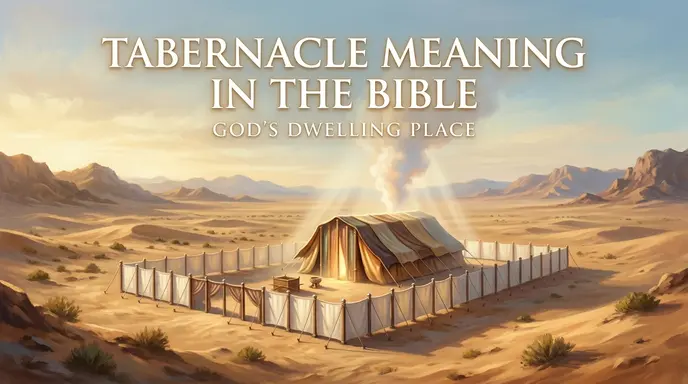
For decades, the Israelites had no permanent home. They lived in tents, moved when told to move, and depended on God for everything.
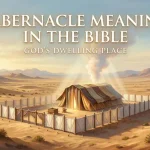
Right at the center of that camp stood a sacred tent unlike any other: the tabernacle. It was a portable sanctuary where worship took place and where God’s presence was said to dwell among His people.
Its name, its design, and even the way it was carried reveal a great deal about holiness, guidance, and nearness to God.
Christians also see its themes fulfilled in Jesus, while Jewish tradition sees its pattern in the synagogue and the festival of Sukkot.
This guide explains what the tabernacle was, why God commanded it, how it worked, and what it still teaches today.
What Is the Tabernacle in the Bible?
The tabernacle was a portable sanctuary that served as Israel’s central place of worship from the exodus until Solomon’s temple was built in Jerusalem. God gave Moses the plans at Mount Sinai, and Exodus 25:8 states the purpose plainly: “Then have them make a sanctuary for me, and I will dwell among them.”
It was not a home for everyday life. It was a holy space where sacrifices were offered, priests served, and the people were reminded that God was in their midst, even in the middle of a desert. The instructions appear in Exodus 25–31, and the account of the actual construction is in Exodus 35–40.
Tabernacle Meaning: The Hebrew and Greek Words
Mishkan
The Hebrew word is mishkan, built on a root meaning “to dwell.” It literally means a dwelling place or residence. The name itself explains the purpose: this was not a monument or a museum, but a place for God’s presence among people.
Ohel Moed
The tabernacle is also called ohel moed, usually translated “tent of meeting.” In Exodus 29:42–46, God promises to meet Israel there, speak with them, and dwell among them. The two names overlap, but each stresses something different: one highlights dwelling, the other highlights meeting.
Skēnē
The Greek Old Testament uses skēnē, meaning tent. A related verb, skēnoō, appears in John 1:14, where the Word became flesh and “dwelt” among us. Many Christians see a deliberate echo of the tabernacle here. This is a connection of language and theme, not a claim that Jesus was literally a tent.
Why Did God Ask Israel to Build the Tabernacle?
After leaving Egypt, the Israelites did not enter the Promised Land right away. Fear at the report of the spies sent them wandering in the wilderness for forty years (Numbers 13–14). A permanent temple made no sense for a people on the move, so God gave them a sanctuary that could travel with them. Wherever they camped, they knew God was with them.
One small detail in Exodus 25:8 stands out. God says He will dwell “among them,” not “in it.” Jewish sages noted this wording and suggested the real goal was larger than a building: God wanted a people and a community that made room for Him. Whatever reading you prefer, the verse makes clear that the tabernacle was about relationship, not architecture.
Who Built the Tabernacle?
Moses oversaw the project, but the whole nation took part. The materials were freewill offerings from the people (Exodus 35:20–29). They gave so generously that Moses had to tell them to stop bringing more (Exodus 36:3–7). Skilled women spun yarn and linen with their own hands (Exodus 35:25).
God also named two craftsmen to lead the work. Bezalel, from the team of Judah, was filled with the Spirit of God and given skill in gold, silver, bronze, stone, and wood. Oholiab, from the team of Dan, was appointed to help him (Exodus 31:1–6). The story shows that practical skills, not only priestly duties, were treated as part of serving God.
Read More: What Does “Dismayed” Mean in the Bible? Meaning, Verses, and Lessons
What Did the Tabernacle Look Like?
The tabernacle had three zones, each with a different level of access.
The Outer Courtyard
A fenced courtyard surrounded the tent. Here stood the bronze altar, where sacrifices were offered, and the bronze basin, where priests washed before serving (Exodus 27, 30:17–21).
The Holy Place
Only priests could enter the first room of the tent. It held three items: the golden lampstand (menorah), the table of the bread of the Presence, and the altar of incense.
The Most Holy Place
A veil separated the Holy Place from the innermost room, also called the Holy of Holies. It held the Ark of the Covenant, with the atonement cover and the cherubim above it. God said He would meet Moses there (Exodus 25:22). Only the high priest could enter, and only once a year on the Day of Atonement (Leviticus 16; Hebrews 9:7).
| Item | Location | Purpose |
| Bronze altar | Courtyard | Burnt offerings |
| Bronze basin | Courtyard | Priestly washing |
| Lampstand | Holy Place | Light for the sanctuary |
| Table of the Presence | Holy Place | Bread set before God |
| Altar of incense | Holy Place | Fragrant incense |
| Ark of the Covenant | Most Holy Place | Covenant tablets; place of meeting with God |
The building materials were fine linen, animal skins, acacia wood, and gold, silver, and bronze. It was beautiful, but portable by design.
How Did Worship Work in the Tabernacle?
Worship centered on priests who served on behalf of the people. Animals were offered on the bronze altar, incense was burned, and fresh bread was placed on the table each week. The priests tended the lampstand daily so that light never left the sanctuary.
The tabernacle also stood at the center of Israel’s calendar. Major observances such as Passover, Shavuot (Pentecost), and the Day of Atonement were tied to the sanctuary. The most serious day was Yom Kippur, when the high priest entered the Most Holy Place to seek forgiveness for himself and the nation (Leviticus 16). The tabernacle was also a gathering place where leaders met and the people came for guidance.
The message was consistent: God is near, but He is holy, and approaching Him requires reverence and the way He has provided.
How Was the Tabernacle Moved?
Israel did not choose when to travel. The cloud of the Lord rested over the tabernacle by day, and fire was in the cloud by night. When the cloud lifted, the camp moved. When it stayed, they stayed, whether for days or years (Numbers 9:15–23; Exodus 40:36–38).
Moving it was organized work. The priests wrapped the sacred objects, and the Levites took the structure apart, carried it, and set it up again at the next camp. The Kohathites carried the most sacred items using poles, since touching them directly was forbidden (Numbers 4:1–20). The seriousness of this is shown later in 2 Samuel 6:7, when Uzzah died after touching the Ark.
Where Was the Tabernacle Set Up?
The Bible does not record the tabernacle at every campsite, but it followed Israel through key moments. At Mount Sinai it stood near the foot of the mountain where the law was given. After Israel entered Canaan, it was set up at Gilgal and then at Shiloh, where it remained through much of the period of the judges. Later it was at Nob, and finally at Gibeon during David’s reign.
When Solomon built the temple in Jerusalem, the permanent house replaced the portable one, and the Ark and other furnishings were brought in (1 Kings 6–8). David had wanted to build that house, but God told him his son would do it (1 Chronicles 17, 22). So the tabernacle and temple were not the same building. The tabernacle was a movable tent; the temple was a permanent structure of stone and cedar.
The Tabernacle in the New Testament
John 1:14
John says the Word became flesh and “tabernacled” among us. Christians see God’s presence, once located in a tent among Israel, now coming near in a person: Jesus Christ.
Hebrews 8–10
Hebrews spends several chapters comparing the earthly tabernacle with Christ’s work. It describes Jesus as a high priest who serves in a greater and more perfect tabernacle (Hebrews 9:11). It also points out that the repeated sacrifices of the old system could not fully remove sin, which is why they had to be repeated (Hebrews 10:1–4). The tabernacle’s limits, such as restricted access, pointed toward something more complete.
Revelation 21:3
The Bible’s story ends with the same theme it began with: a voice declares that God’s dwelling is with humanity. The tabernacle’s story is part of a longer arc of God drawing near to His people.
A word of caution: Christians have often assigned symbolic meaning to every curtain, color, and furnishing. Scripture explains the purpose of many items, but not every later interpretation is stated in the text. The safest approach is to read Exodus and Leviticus first, then see how Hebrews and John interpret them.
The Tabernacle and Sukkot
Today, the word “tabernacle” also appears in the Jewish holiday of Sukkot, the Festival of Tabernacles. Families build a temporary shelter, a sukkah, and eat in it for seven days. It recalls both the harvest and Israel’s years of living in tents in the desert. The ancient tabernacle and the sukkah are different things, but they share a message: God is present with His people even in temporary, fragile places.
The tabernacle’s influence also continues in synagogues. Many have an ark holding the Torah scrolls, a lamp that is always lit, and a raised platform for reading, echoing the Ark, the lampstand, and the altar.
What Does the Tabernacle Teach Today?
God wants to be near His people. The central point of Exodus 25:8 has not changed. The Bible presents a God who moves toward people, not away.
Worship deserves reverence. The tabernacle’s boundaries and priestly rules taught Israel that God is not to be approached casually. Christians don’t rebuild those rules, but they can approach prayer and worship with humility and sincerity.
Everyone’s contribution matters. Gold donors, spinners, and master craftsmen all had a share in the work. Communities of faith are built the same way.
God’s guidance requires patience. Israel waited for the cloud. Today, seeking direction means prayer, Scripture, and wise counsel, not looking for dramatic signs in ordinary events.
FAQs
What does the tabernacle mean in the Bible?
It means a dwelling place. The tabernacle was a portable sanctuary where God’s presence was among Israel, and where priests offered worship and sacrifices on the people’s behalf.
Why did God tell Moses to build the tabernacle?
Exodus 25:8 gives the reason: God wanted a sanctuary so He could dwell among His people. It also gave Israel a place of worship that could travel with them through the wilderness.
What was inside the tabernacle?
The Holy Place held the lampstand, the table of the bread of the Presence, and the altar of incense. The Most Holy Place held the Ark of the Covenant. In the courtyard stood the bronze altar and the bronze basin.
Who was allowed to enter the Most Holy Place?
Only the high priest, and only once a year on the Day of Atonement. He entered with blood and incense, following the instructions in Leviticus 16.
What is the difference between the tabernacle and the temple?
The tabernacle was a portable tent used from the exodus until the time of David and Solomon. The temple was a permanent building constructed in Jerusalem by Solomon, and it took over the tabernacle’s role.
How does the tabernacle point to Jesus?
Christians connect the dwelling language of John 1:14 with the tabernacle and read Hebrews 8–10 as describing Jesus as the high priest who brings believers fully into God’s presence. These connections are best read in their own context.
Is the tabernacle the same as the Feast of Tabernacles?
No. The tabernacle was the sanctuary. The Feast of Tabernacles (Sukkot) is a holiday in which people live in temporary shelters to remember the wilderness years and give thanks for the harvest.
Do Christians need a tabernacle today?
No. The New Testament does not tell Christians to rebuild it. Hebrews treats the tabernacle as part of the old covenant, and Christians believe access to God now comes through Jesus Christ.
Conclusion
The tabernacle was far more than an ancient tent. It was a carefully designed sanctuary through which God showed Israel that He was present, holy, and willing to be approached on the terms He set.
For Christians, the story continues in Jesus, who “dwelt among us,” and ends in the promise of Revelation 21:3 that God will live with His people.
To understand the tabernacle well, start with Exodus, read it alongside Hebrews, and let the text, not guesswork, guide the meaning.

I am Rebecca Collins, a Christian writer and Bible researcher at BibleMeaningHub.com. I share insightful biblical interpretations and faith-based teachings to help readers better understand Scripture. My mission is to encourage spiritual growth and strengthen faith through God’s Word.

2 thoughts on “What Was the Tabernacle in the Bible? Meaning, Purpose, and Why It Still Matters”