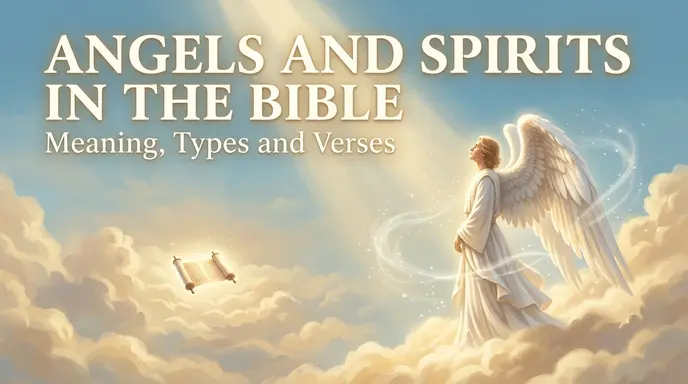
Angels appear at some of the Bible’s most memorable moments. One announces Jesus’ birth, one shuts the mouths of lions, and one frees Peter from prison.
Yet the words used for angels, and for spirits more broadly, are often misunderstood. Is an angel the same as a spirit?
Are cherubim and seraphim different names for the same being? And does the Bible actually describe “celestial” angels the way popular art does?
This guide explains what Scripture says. You will learn the original Hebrew and Greek words, the different heavenly beings the Bible describes, what angels do, how evil spirits fit in, and how to separate biblical teaching from later tradition.
What Do “Angel” and “Spirit” Mean in the Bible?
Two words cause most of the confusion. Once you know where they come from, many passages become much clearer.
Angel Means “Messenger”
The Hebrew word malak and the Greek word angelos both mean “messenger.” They describe a job, not a type of creature. In most passages the messenger is a heavenly being sent by God. In others the same word describes a human messenger, such as a prophet, a priest, or a traveler carrying news. The context tells you which meaning is intended.
Spirit Means Breath, Wind, or Life
The Hebrew word ruach and the Greek word pneuma can each mean wind, breath, or spirit. This is why Jesus can play on the double meaning in John 3:8, where the same word covers both wind and Spirit. Depending on the passage, “spirit” can refer to:
- God’s Spirit, the Holy Spirit
- The inner life of a human being
- Angels, as in Hebrews 1:14
- Evil or unclean spirits, as in Mark 1:23–27
So not every spirit is an angel, and the Holy Spirit is never presented as an angel. He is God.
Is “Celestial” a Biblical Word?
“Celestial” simply means “heavenly.” The phrase “celestial angels” is therefore a description, not a title Scripture gives to one special group. The Bible speaks instead of angels, the heavenly host, cherubim, seraphim, and “holy ones.” Treating them all as one category leads to guesswork, so it is wiser to read each passage on its own terms.
Read More: Daily Bible Verse Meaning in the Bible: A Christian Guide
Heavenly Beings Described in Scripture
The Bible does not give a complete chart of the unseen world. It gives glimpses, each fitted to its setting.
Angels and Archangels
Angels are the most common heavenly beings in Scripture. Two are named: Gabriel, who speaks to Daniel and later to Mary (Daniel 8:16; Luke 1:26–38), and Michael, who appears in Daniel 12:1 and Jude 9. The word “archangel” is used only twice in the New Testament, in 1 Thessalonians 4:16 and Jude 9. The Bible never lists a ranked set of archangels. Detailed rankings, such as the nine orders found in some church writings, come from later tradition.
Cherubim
Cherubim are connected with God’s presence and holiness. They guard the way to Eden in Genesis 3:24, their images were placed over the ark of the covenant (Exodus 25:18–22), and they appear in Ezekiel’s vision of God’s glory (Ezekiel 10). They are not the chubby infants of Renaissance art. In Scripture they are powerful and awe-inspiring.
Seraphim
Seraphim appear in Isaiah 6:1–7. They have six wings, call out “Holy, holy, holy,” and one touches Isaiah’s lips with a burning coal to cleanse him. The scene is about God’s purity far more than about the creatures themselves.
The Heavenly Host
“Host” means army or company. In Luke 2:13–14, a great company of the heavenly host praises God at Jesus’ birth. The title “Lord of hosts” presents God as ruler over all heavenly forces.
The Angel of the LORD
In passages such as Genesis 16, Exodus 3, and Judges 6, the “angel of the LORD” appears and sometimes speaks as though he were God himself. Many Christians see this as a special appearance of God, and some see it as an appearance of Christ before his birth. Other readers see an exceptional messenger acting with God’s authority. Because Christians interpret these passages differently, it is best to hold the conclusion with humility.
Comparing the Terms at a Glance
| Term | Basic meaning | Key passage |
| Angel | Messenger or heavenly servant | Luke 1:26–38 |
| Archangel | Chief angel (Michael in Jude 9) | 1 Thessalonians 4:16 |
| Cherubim | Beings linked to God’s presence and glory | Ezekiel 10 |
| Seraphim | Beings who proclaim God’s holiness | Isaiah 6:1–7 |
| Heavenly host | Heavenly company that serves and praises God | Luke 2:13–14 |
| Spirit | Breath, wind, or spiritual being, by context | Hebrews 1:14 |
| Holy Spirit | God’s own Spirit | John 14:26 |
What Do Angels Do in the Bible?
Scripture gives angels a handful of clear roles. Religious scholars studying many traditions note that angels everywhere are linked to praising God and carrying out his will, and the Bible fits that pattern.
They Deliver God’s Messages
Gabriel announces the births of John the Baptist and Jesus. An angel warns Joseph in a dream to flee to Egypt (Matthew 2:13). Angels at the empty tomb tell the women that Jesus has risen (Matthew 28:5–7). In each case the focus stays on the message, not on the messenger.
They Worship God
Isaiah 6 and Revelation 4–5 show heavenly beings in constant worship. Their worship points to the greatness of the Creator and gives readers a model of reverence.
They Serve and Protect
Hebrews 1:14 calls angels “ministering spirits sent to serve those who will inherit salvation.” After Jesus resists temptation in the wilderness, angels come and care for him (Matthew 4:11). An angel strengthens the exhausted prophet Elijah with food (1 Kings 19:5–7). In Acts 12:5–11, an angel leads Peter out of prison while the church is praying.
These stories are encouraging, but they are not guarantees. Other faithful believers in the Bible suffered or died without rescue. Divine help is real, yet Scripture never gives people control over when or how angels act.
They Carry Out God’s Judgment
Angels also serve as instruments of judgment. In Genesis 19, angels lead Lot out before Sodom is destroyed, and Revelation describes angels carrying out judgments at the end of the age. Their power is always exercised under God’s command.
When the Bible Calls a Human an “Angel”
Because malak and angelos simply mean “messenger,” the Bible sometimes applies them to people:
- Priests: Malachi 2:7 calls the priest the “messenger” of the LORD of hosts.
- John the Baptist: Mark 1:2 calls him God’s “messenger” who prepares the way for Jesus, using the same Greek word as for heavenly angels.
- The seven churches: The letters in Revelation 2–3 are addressed to the “angel” of each church. Some readers think this means a human leader or representative, while others see a heavenly being. Scholars still disagree.
This shows why reading the context matters. If you assume every “angel” is a winged heavenly being, you will misread several passages.
Fallen Angels and Evil Spirits
The Bible also speaks of spirits that oppose God. Jude 6 and 2 Peter 2:4 refer to angels who sinned and were judged. Revelation 12:7–9 pictures a conflict in heaven in which Satan and his angels are defeated. In the Gospels, Jesus meets people troubled by unclean spirits and commands them to leave (Mark 1:23–27).
Many Christians have traditionally taught that Satan was an angel who fell through pride, and that demons are fallen angels. The Bible hints at this but does not spell out every detail, so Christians hold different views on the specifics.
What the Bible does stress is the outcome. Evil is real, but it is not equal to God. Paul tells believers to stand firm in truth, righteousness, faith, and prayer (Ephesians 6:10–18). He does not tell them to chase after demons or blame every hardship on them. First John 4:1 gives practical advice that fits our age as well: “test the spirits” rather than believing every spiritual claim.
Key Bible Verses About Angels and Spirits
Hebrews 1:14. Angels are “ministering spirits” sent to serve believers. The whole chapter argues that the Son is greater than the angels, so this verse places angels in service, not in authority over Christ.
Psalm 103:20–21. Angels are “mighty ones who do his word.” They obey God and do not act independently of him.
Isaiah 6:1–7. Seraphim proclaim God’s holiness, and Isaiah is cleansed and commissioned. The lesson is reverence for God.
Luke 1:26–38. Gabriel brings Mary the news of Jesus’ birth. Mary asks an honest question and then accepts God’s plan.
Psalm 91:11. God “will command his angels concerning you to guard you.” Notice that Satan quotes this verse to tempt Jesus in Matthew 4:6, so it should never be used as a promise of a life without danger.
Hebrews 13:2. “Do not forget to show hospitality to strangers, for by so doing some people have shown hospitality to angels without knowing it.” The verse encourages kindness. It does not ask us to look for angels.
Revelation 22:8–9. John falls down before the angel, who refuses and tells him, “Worship God!” This is one of the clearest statements about angels in the Bible.
Common Misunderstandings
“All angels have wings.”
Cherubim and seraphim are described with wings, but most angels in the Bible look like ordinary men. In Genesis 18–19, the visitors to Abraham and Lot are seen as human travelers. At the tomb, Mark 16:5 describes “a young man” in a white robe. Wings in art are a symbol of the spiritual nature of these beings. They are not a biblical rule.
“People become angels when they die.”
The Bible never says this. Angels are presented as created beings, made by God before and separately from humans (Psalm 148:2–5). Believers who die are described as being with the Lord, not as becoming angels.
“Everyone has a personal guardian angel.”
Matthew 18:10 speaks of children’s angels, and Psalm 91:11 speaks of angels guarding God’s people, but the Bible does not give a full doctrine of personal guardian angels. Christian traditions differ here, and the belief is especially strong in Roman Catholic teaching.
“Angels can be prayed to or worshiped.”
Colossians 2:18 warns against the worship of angels, and Revelation 22:8–9 shows an angel rejecting worship. Scripture directs prayer and worship to God alone.
“Angels guarantee our safety.”
Biblical accounts of rescue are real, but they are specific events. Scripture also records faithful people who endured prison, illness, and martyrdom. Trusting God does not mean expecting a danger-free life.
Practical Lessons for Today
Keep God at the center. Angels in the Bible always point away from themselves to God. Your interest in them should do the same.
Test every spiritual claim. Paul warns in Galatians 1:8 that even a message claiming to come from an angel must match the gospel. Be careful with secret angel names, hidden ranks, and promises of special spiritual power.
Live without fear. The Bible acknowledges unseen forces without asking believers to live afraid of them. Prayer, Scripture, and honest Christian community are the biblical response.
Serve like the angels. Angels in Scripture do what God asks, quietly and faithfully. Christians can follow that example through humble, practical service to others.
FAQs
1. Are angels and spirits the same thing?
Not always. Angels are heavenly messengers, and Hebrews 1:14 calls them “ministering spirits.” But “spirit” has a much wider meaning. It can refer to the Holy Spirit, a human spirit, or an evil spirit. Context decides.
2. What types of angels does the Bible mention?
Scripture mentions angels, archangels (Michael in Jude 9), cherubim, seraphim, and the heavenly host. It also describes the “living creatures” of Revelation 4. The Bible does not give a full ranking of these beings.
3. Are there guardian angels?
Psalm 91:11 and Matthew 18:10 suggest that God sometimes uses angels to protect and watch over his people. The Bible does not clearly teach that every person has one assigned angel, and Christian traditions differ on this point.
4. Do angels have wings?
Only cherubim and seraphim are described with wings. Many angels in the Bible appear as ordinary men. Wings in art are mainly a symbol of their spiritual nature.
5. Do people become angels after death?
No. The Bible presents angels as a separate order of created beings, not as the spirits of humans who have died.
6. Should Christians pray to angels?
Scripture directs prayer and worship to God alone. Revelation 22:8–9 shows an angel refusing John’s worship, and Colossians 2:18 warns against angel worship.
7. Are demons fallen angels?
Many Christians believe so, based on passages such as Jude 6, 2 Peter 2:4, and Revelation 12:7–9. The Bible does not spell out every detail, so the exact origin of demons is explained in different ways.
8. Does the Bible ever call humans “angels”?
Yes. Because the original words mean “messenger,” priests (Malachi 2:7) and John the Baptist (Mark 1:2) are called messengers. Some interpreters think the “angels” of the seven churches in Revelation were human leaders.
Conclusion:
The Bible’s teaching on angels and spirits is clearer than popular culture makes it seem.
Angel” means messenger, and “spirit” is a wide word covering breath, wind, human life, God’s Spirit, and other spiritual beings.
Scripture describes angels, cherubim, seraphim, and the heavenly host, but it does not give a complete map of the unseen world.
Angels deliver messages, worship, serve, and carry out God’s will, always under his authority. Evil spirits are real but defeated.
The best response is to study each passage in context, test every claim against Scripture, and keep your trust and worship fixed on God.





1 thought on “Angels and Spirits in the Bible: Who They Are, What They Do, and What Scripture Really Says”