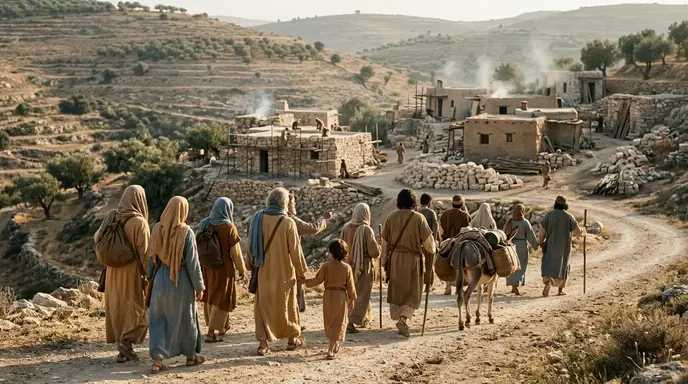
What happens to God’s promises when most people walk away from Him? The Bible answers with a quiet but powerful idea: the remnant.
From Noah’s family to Elijah’s seven thousand to the believers Paul describes in Romans, Scripture keeps returning to a group that remains when much has been lost.
The remnant meaning in the Bible holds warning and hope together. It speaks of judgment that is real, and of a God who still preserves people for His purposes.
It also humbles us, because Paul says this remnant exists by grace, not achievement.
In this guide, you will see the Hebrew and Greek words, the key verses in context, how different Christians read the end-time remnant, and what the theme means for daily faith.
What Does Remnant Mean in the Bible?
In everyday English, a remnant is what is left over: the last stretch of fabric on a roll, or the survivors after a disaster. The Bible builds on that simple idea. A remnant is the part that remains after a larger group has been lost, scattered, or judged.
Yet a biblical remnant is never treated as scraps. Again and again, the people who remain are the ones through whom God carries His promises forward.
The Hebrew Words
The main Hebrew noun is she’erit (שְׁאֵרִית), meaning “remainder,” “remnant,” or “survivors.” It grows from the root sha’ar, “to be left” or “to remain.” A related idea, peletah, stresses escape and deliverance. Different passages use different words, so the English word “remnant” does not always translate the same Hebrew term.
The Greek Words
In Romans 11:5, Paul uses leimma (λεῖμμα), “remnant” or “remainder,” which comes from a verb meaning “to leave.” In Revelation 12:17, the Greek word is loipos, meaning “the rest” or “the remaining ones.” That is why some translations say “remnant” there while others say “the rest of her offspring.”
Survivors, Faithful People, or Both?
The meaning depends on the passage. So a remnant may be survivors, faithful believers, or both, and the context decides.
Read More: What Was the Tabernacle in the Bible? Meaning, Purpose, and Why It Still Matters
Historical Background: Why Survival Mattered
In the ancient world, war, famine, and forced migration could erase entire communities. A surviving group might carry a people’s family lines, worship, and hope for the future.
For Israel, survival also carried covenant meaning, because God’s promises to Abraham and his descendants continued even after judgment. The prophets therefore pushed back on the idea that national identity alone brought safety, calling people to repent and trust God. In that setting, “remnant” combined historical survival with a spiritual question: who will remain faithful?
Remnant Stories Across the Bible
Noah and Lot: Rescued From Judgment
The pattern appears even where the word “remnant” does not. Noah found favor with the LORD (Genesis 6:8), and his family was carried through the flood. In Genesis 19, Lot and his two daughters escaped the destruction of Sodom. In both stories, a few are preserved while judgment falls on many.
Joseph: A Family Preserved
Joseph told his brothers that God sent him ahead to preserve a remnant on earth and keep many alive (Genesis 45:7). The story does not excuse what his brothers did. It shows that God can bring survival and good out of painful events.
Elijah: Not as Alone as He Felt
After confronting the worship of Baal, Elijah fled and told God he was the only one left (1 Kings 19:10, 14). God replied that He had kept seven thousand in Israel who had not bowed to Baal (1 Kings 19:18). Elijah’s loneliness was real, but it was not the full picture. Paul later uses this very story in Romans 11:2–4.
Exile and Return: The Prophets’ Hope
The prophets warned that sin and injustice would bring consequences, yet they also spoke of survivors. Isaiah 10:20–22 promises a remnant that will return to the Mighty God. Isaiah 11:11 pictures the Lord recovering the remnant of His people from many lands. Jeremiah 23:3 and Micah 2:12 speak of gathering what remains. Ezra 9:8 looks back on the return from exile and describes it as a moment of grace that left a remnant.
Paul: A Remnant Chosen by Grace
In Romans 9:27, Paul quotes Isaiah to show that although Israel’s descendants are many, a remnant will be saved. In Romans 11:1–5, he asks whether God has rejected His people. His answer is no. Paul himself is an Israelite who follows Jesus, and he points to Elijah’s day as proof that God had kept a faithful people. This remnant, he says, exists by grace and not by works (Romans 11:5–6).
Key Remnant Bible Verses at a Glance
| Verse | Who remains | Main point |
| Genesis 45:7 | Joseph’s family | Preservation during famine |
| 1 Kings 19:18 | Seven thousand faithful in Israel | God knows faithful people we cannot see |
| 2 Kings 19:30–31 | Survivors of Judah | Renewal after invasion |
| Isaiah 10:20–22 | Survivors of Israel | Return and reliance on God |
| Isaiah 11:11 | God’s scattered people | Gathering and restoration |
| Micah 5:7–8 | Remnant of Jacob among the nations | A significant presence |
| Zephaniah 3:12–13 | A humble, truthful people | The character of those who trust God |
| Romans 9:27 | Remnant of Israel | Judgment alongside preservation |
| Romans 11:5 | Believing Jews in Paul’s day | Chosen by grace |
Who Is the Remnant? Three Common Readings
Christians do not all answer this question the same way. Three readings appear most often:
- Faithful people in every age. Some read the remnant as God’s faithful people throughout history, from Noah’s household to believers today. On this view, the church can be seen as a faithful continuation of Israel’s story (Romans 11).
- Jewish believers in Paul’s time. Others stress that Romans 11:5 refers specifically to Jewish followers of Jesus, a sign that God had not rejected Israel.
- An end-time group. Revelation 12:17 describes the dragon making war on the rest of the woman’s offspring, who keep God’s commandments and hold to the testimony of Jesus. Seventh-day Adventists understand this as an end-time remnant with a mission to proclaim the message of Revelation 14:6–12, while also teaching that the universal church includes all who truly believe in Christ. Other Christians read the verse as a picture of all believers under pressure in the last days.
These readings overlap in places. What they share is the conviction that the remnant is defined by faithfulness to God and by His grace, not by a label. Whatever view you hold, Scripture’s own warning stands: no one should boast (Romans 11:18).
Spiritual Meaning and Life Lessons
God Stays Faithful When People Do Not
Human failure does not cancel God’s purposes. Israel faced real consequences for disobedience, yet the prophets still spoke of survivors and a future. This does not mean every hardship is God’s punishment, since Scripture names many causes of suffering. It does mean that God can preserve hope even after great loss.
Judgment and Mercy Meet
The remnant often appears where warning and mercy meet. If we hear only judgment, we miss the invitation to return. If we hear only comfort, we miss the call to repent. Isaiah 10:20–22 holds both: the nation is struck, and a remnant learns to trust the Lord.
Humility, Not Pride
Paul tells Gentile believers not to boast over the branches of the olive tree (Romans 11:17–24). The remnant exists because of grace, so it gives no one a reason to look down on others. Being part of God’s people should produce gratitude and kindness, not superiority.
Mission and Responsibility
Being among God’s faithful people brings responsibility more than status. Faith is meant to show in honest speech, fair dealing, and care for others, and in sharing the hope we have received.
Hope After Loss
The return from exile shows that loss does not have to be the final chapter. Restoration may be slow and may look different from what came before, but the Bible repeatedly presents God as the One who gathers and rebuilds. Be careful, though, not to treat every national promise as a direct promise about your personal situation.
Common Misunderstandings About the Remnant
- “The remnant is a tiny group of perfect people.” The word means a remaining portion. Some passages stress survival, others faithfulness, and none says its members are flawless.
- “It is the same group in every passage.” Joseph’s family, Judah’s survivors, and Paul’s Jewish believers belong to different historical settings.
- “Small numbers prove a group is right.” Scripture shows that God’s people can be few, but being few is not evidence of being faithful. Truth is tested by Scripture, not by size.
- “Any church can declare itself the only true remnant.” The biblical theme warns against pride, so such claims need careful, humble examination.
- “The remnant theme is only about punishment.” Judgment is part of the story, but so are preservation, mercy, return, and hope.
How to Study Any Remnant Passage
Ask three questions each time:
- Who remains? Identify the family, nation, or community.
- What happened first? Look for the war, famine, exile, or judgment behind the passage.
- What is the emphasis? Is it survival, repentance, restoration, faithfulness, or grace?
Then compare related passages, such as Isaiah 10:20–22 and Romans 11:5, and notice how Paul draws on the Old Testament.
FAQs
What does remnant mean in the Bible?
In the Bible, a remnant is the part that remains after a larger group has faced loss, judgment, war, or exile. The Hebrew word she’erit means “remainder” or “survivors.” In some passages the remnant simply survives; in others it is a faithful group that God preserves by His grace and mercy.
What does Romans 11:5 mean?
Romans 11:5 says that, at the present time, a remnant exists according to God’s gracious choice. Paul is answering whether God has rejected Israel. His answer is no: just as God kept seven thousand faithful people in Elijah’s day, He preserved Jewish believers in Paul’s day, and Paul stresses that this happens by grace, not works.
Who is the remnant of Israel?
The remnant of Israel means the part of Israel that God preserves through judgment or exile. In Isaiah 10:20–22 it describes survivors who return to the Lord. In Romans 9–11, Paul applies it to Jewish believers in his own time, showing that God’s promises to Israel were not cancelled.
Is the remnant always a faithful group?
Not always. The word can mean survivors or whatever is left after a disaster. Passages like 1 Kings 19:18 and Zephaniah 3:12–13 emphasize faithfulness and humility, while others, such as Genesis 45:7, focus on physical survival. The surrounding context shows which meaning the author intends.
What is the remnant in Revelation 12:17?
Revelation 12:17 describes the dragon making war on “the rest” (or remnant) of the woman’s offspring, who keep God’s commandments and hold the testimony of Jesus. Christians interpret this differently. Some see all faithful believers in the last days; Seventh-day Adventists see themselves as part of an end-time remnant movement.
Does the remnant mean only a few people will be saved?
Not necessarily. Romans 9:27 says a remnant of Israel will be saved, and Matthew 7:13–14 speaks of a narrow way with few finding it. Yet Scripture also shows God’s wide mercy and invitation to all. The remnant theme highlights God’s grace and faithfulness more than it gives a headcount.
Can a church or group call itself the only remnant?
The Bible does not give any group permission to claim superiority. Paul warns Gentile believers against boasting in Romans 11:17–24 and says the remnant exists by grace. A church can seek faithfulness, but claims of being the only true remnant should be tested carefully against Scripture and marked by humility.
How can Christians apply the remnant theme today?
Stay faithful in ordinary choices, remember you are not alone, and respond to God’s grace with humility. Elijah felt isolated, yet God had thousands who were faithful. Seek Christian community, speak honestly, treat others fairly, and trust that God’s purposes continue even when circumstances look discouraging.
Conclusion:
The remnant meaning in the Bible comes down to this: when much is lost, God still preserves people and keeps His promises.
Sometimes the remnant is a family rescued from famine, sometimes a faithful few like Elijah’s seven thousand, and sometimes the believers Paul describes in Romans 11:5.
The theme carries warning, because sin has consequences. It carries hope, because judgment is never the last word.
And it carries humility, because the remnant stands by grace. Read each passage in its own setting, hold your convictions with gratitude rather than pride, and trust the God who remains faithful.

I am a Christian writer and Bible researcher passionate about making Scripture easy to understand. Through biblical meanings, Hebrew insights, and faith-based studies, I help readers grow in their knowledge of God’s Word and strengthen their walk with Christ.








1 thought on “Remnant Meaning in the Bible: Who Are God’s Remnant?”