Life can sometimes feel uncertain and out of control. In those moments, remembering who truly rules over everything brings peace and hope.
This is where the name Adonai becomes so meaningful. More than just a title for God, it reminds us that He is our Lord, Master, and the One who is in complete control.
If you’ve ever wondered about the Adonai meaning in the Bible, this article will explain its Hebrew origin, biblical significance, and the powerful spiritual lessons it offers for your faith, prayer, and daily walk with God.
📖 Quick Answer: What Does Adonai Mean in the Bible?
Adonai is a Hebrew name for God that means “Lord” or “My Lord.” It comes from the root word adon, meaning master or owner. In the Bible, it expresses God’s absolute authority and lordship over all creation. Jewish tradition uses Adonai in place of the sacred name YHWH (Yahweh) when reading Scripture aloud, out of deep reverence.
The Hebrew Meaning of Adonai🔤
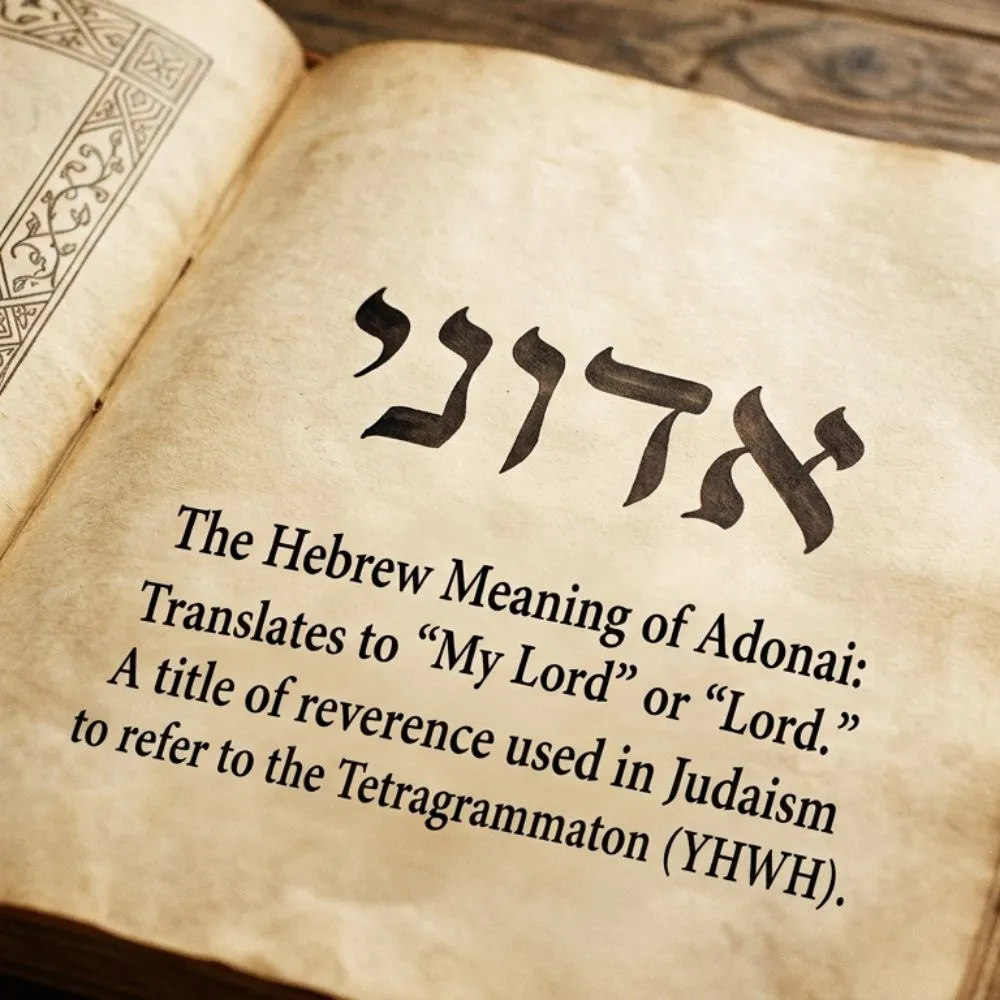
The word Adonai (אֲדֹנָי) is rooted in the Hebrew word adon (אָדוֹן), which simply means “lord,” “master,” or “owner.” The suffix -ai transforms it into a first-person plural possessive, meaning “my Lords” — a plural of majesty used to express the infinite greatness of God.
In ancient Hebrew culture, the word adon was also used for human masters or rulers. But when applied to God, it took on a completely elevated and sacred meaning — one that communicated His supreme authority over all people and all things.
The literal meaning is “my Lord” or “my Master.” The spiritual meaning goes much deeper: it is a declaration of submission, trust, and surrender to the One who holds all things in His hands.
This name appears over 430 times in the Old Testament, making it one of the most frequently used names for God in all of Scripture.
Historical and Biblical Context of Adonai📜
Old Testament Usage
In the Old Testament, Adonai was used widely by prophets, kings, and worshippers. The prophet Isaiah encountered God in a vision and cried out, “Woe is me! For I am undone!” (Isaiah 6:1–5). He refers to God as “Adonai” — the Lord seated on a high and exalted throne.
Moses used this name when he felt inadequate for his calling:
O my Lord, I am not eloquent… (Exodus 4:10)
The use of Adonai in these moments reveals something important: this name is often spoken when people are standing before God in absolute humility, recognizing He is the Master and they are the servants.
In Jewish tradition, whenever the divine name YHWH (the Tetragrammaton) appeared in text, readers would say Adonai out loud instead — a practice born from the third commandment, to not take God’s name in vain. This tradition preserved the sacred reverence for God’s identity.
New Testament Relevance
While the New Testament was written in Greek, the concept behind Adonai is directly reflected in the Greek word Kyrios (Κύριος), which also means “Lord.” When Jesus is called “Lord” throughout the New Testament, this carries the same weight as Adonai in the Old Testament.
In Philippians 2:11, Paul writes that “every tongue should confess that Jesus Christ is Lord (Kyrios)” — a direct echo of the lordship expressed in the name Adonai. This connection beautifully links the two Testaments under the same sovereign God.
Is Adonai in the Bible? Where and Why It Matters✝️
Yes — Adonai appears throughout the Hebrew Bible in nearly every book. Here are a few key contexts where this name carries special weight:
- Genesis — God as the sovereign Creator and Owner of all life
- Psalms — Worshippers calling on God as their ultimate Master
- Isaiah — The prophet’s encounters with God’s majestic lordship
- Ezekiel — Repeated use of “Lord God” (Adonai YHWH) over 200 times
Why does this matter for believers? Because every time the name Adonai appears, it is an invitation. An invitation to recognize that God is not just a distant figure — He is your Lord, your personal Master, who cares about every detail of your life.
🌙 Adonai in Prayer, Dreams, and Spiritual Experience
Many Christians report that in moments of deep prayer or even in dreams, the sense of God’s lordship becomes overwhelmingly real. When you feel a presence of peace and authority that you cannot explain — when something inside you whispers “He is in control” — that is the reality of Adonai being made known to your spirit.
In times of spiritual confusion or hardship, praying with the name Adonai can be especially powerful. You are not just calling out a title — you are declaring a covenant truth: that God is your Lord and you are under His care and covering.
If you have ever dreamed of a throne, a great light, or a figure of overwhelming authority, Christian interpreters often see these as reflections of God’s majesty — the Adonai who reigns above all. Such experiences are not meant to frighten but to comfort. They remind us that the same God who sat on the throne in Isaiah’s vision is the same Lord who walks beside you today.
The key is to bring these experiences back to Scripture and prayer, asking God to reveal what He wants you to understand about His lordship in your life.
Spiritual Meaning and Symbolism of Adonai🙏

Understanding the Adonai meaning spiritually transforms how we see our relationship with God. Here are the deep spiritual truths this name reveals:
1. God Is the Owner of Everything When you call God “Adonai,” you are acknowledging that He owns your life, your plans, your future, and your present. This is an act of beautiful surrender.
2. We Are Called to Submission In biblical culture, a servant’s highest honor was to serve a great master faithfully. Calling God Adonai means accepting the role of a willing servant — not out of fear, but out of love and trust.
3. Lordship Brings Security A good master protects what belongs to him. When God is your Adonai, you are under divine protection. This is not a burden — it is a blessing.
4. It Points to Christ Every time we see God addressed as Adonai in the Old Testament, we are seeing a preview of Jesus — the one Paul calls “the Lord of lords” (1 Timothy 6:15). The lordship of God reaches its fullest expression in Jesus Christ.
Key Bible Verses About Adonai (Lord)📖
Here are powerful Scriptures where the concept of God as Adonai — Lord and Master — is beautifully displayed:
1. Isaiah 6:1
“In the year that King Uzziah died, I saw the Lord (Adonai) sitting upon a throne, high and lifted up.”
Explanation: Isaiah’s vision powerfully captures the majesty of Adonai. God is not distant — He is enthroned and exalted. This verse reminds us that no earthly ruler compares to our sovereign Lord.
Practical Lesson: When earthly leaders fail or die, God’s throne remains. Fix your eyes on Adonai.
2. Psalm 8:1
“O Lord (Adonai), our Lord, how excellent is Your name in all the earth!”
Explanation: David opens this psalm with wonder. He acknowledges God as both the universal Lord (Adonai) and the personal Lord of his people. Creation itself reflects the greatness of His name.
Practical Lesson: Let the beauty of creation draw you into worship of Adonai every single day.
3. Psalm 110:1
“The Lord (YHWH) said to my Lord (Adonai): Sit at My right hand…”
Explanation: This verse, quoted by Jesus in Matthew 22, connects Adonai to the Messianic promise. It points directly to Christ’s exalted lordship — seated at the Father’s right hand.
Practical Lesson: Jesus is your Adonai. Trust His authority over every area of your life.
4. Exodus 4:10
O my Lord (Adonai), I am not eloquent…
Explanation: Moses’ honest confession to God shows us how to approach Adonai — with humility and transparency. God did not reject Moses in his weakness. He empowered him.
Practical Lesson: You do not have to be perfect to serve Adonai. Bring your weakness to Him and watch Him work.
5. Habakkuk 3:19
“The Lord (Adonai) God is my strength; He will make my feet like deer’s feet…”
Explanation: The prophet Habakkuk was surrounded by trouble, yet he declared trust in Adonai. The imagery of deer’s feet speaks of agility and confidence even on high, dangerous ground.
Practical Lesson: When life feels unstable, let Adonai be your strength. He will steady your steps.
6. Nehemiah 1:11
“O Lord (Adonai), I pray, please let Your ear be attentive to the prayer of Your servant…”
Explanation: Nehemiah’s prayer is one of the most intimate in all of Scripture. He addresses God as Adonai — Lord — and humbly positions himself as a servant making a request of his Master.
Practical Lesson: Prayer to Adonai is not demanding — it is a servant speaking to a gracious Master who listens.
7. Ezekiel 2:4
“And He said to me, ‘Son of man, I am sending you to the children of Israel… Thus says the Lord God (Adonai YHWH)…'”
Explanation: Ezekiel uses the combined title Adonai YHWH throughout his book — emphasizing both God’s personal covenant name and His supreme lordship. It is one of the richest expressions of God’s identity in Scripture.
Practical Lesson: God sends us from a place of His authority. We go in His name, not our own strength.
Life Lessons for Christians from the Name Adonai🌱
Understanding the Adonai meaning is not just an intellectual exercise — it must change how we live. Here are practical ways this name speaks into your daily walk with God:
1. Surrender Control Daily Every morning, practice saying: “Lord, You are Adonai — You are in charge today.” This simple act of surrender is a form of worship.
2. Pray With Confidence When you know God is your Lord and Master, you pray differently. You come boldly, knowing He hears His servants.
3. Choose Eternal Things Over Temporary Ones A servant aligns their priorities with their master’s. When God is your Adonai, your priorities shift from fleeting pleasures to eternal purposes.
4. Walk in Humility Acknowledging God as Lord keeps pride at bay. You cannot call Him “Master” and then live as if you are the one running the show.
5. Trust His Plan, Even in Pain The Lord who holds all things together has not dropped your situation. Adonai is still enthroned, even when life feels chaotic.
❓ FAQs
What does Adonai mean in Hebrew?
Adonai comes from the Hebrew root adon, meaning “lord” or “master.” The suffix transforms it into “my Lord” — a first-person expression of personal submission to God. It is a plural of majesty, used to honor God’s infinite greatness and authority over all of creation and life.
Why do Jewish people say Adonai instead of God’s real name?
In Jewish tradition, the divine name YHWH (Yahweh) is considered too sacred to pronounce. . This practice reflects deep respect and awe for God’s holy identity.
Is Adonai the same as Yahweh?
No — they are different names with distinct meanings. Yahweh (YHWH) is God’s personal covenant name, meaning “I AM WHO I AM.” Adonai means “Lord” and expresses His authority and mastery.
How is Adonai connected to Jesus in the New Testament?
The Greek equivalent of Adonai is Kyrios, meaning “Lord.” When the New Testament calls Jesus “Lord” (Kyrios), it carries the same weight as Adonai in the Old Testament.
How can I use the name Adonai in my prayer life?
Simply begin your prayers by saying, “Adonai, my Lord…” and allow that posture to shape how you pray. Recognizing God as Lord invites humility, trust, and reverence into your prayer time. It shifts the focus from your own plans and needs to His sovereignty. Many believers find that praying using God’s names deepens their spiritual connection significantly.
Does Adonai appear in the New Testament?
The exact Hebrew word Adonai does not appear in the Greek New Testament, but its meaning is fully present through the Greek word Kyrios (Lord).
What is the difference between Adonai and Elohim?
Elohim refers to God as the all-powerful Creator — His strength and cosmic authority. Adonai emphasizes His role as Lord and Master — the relational and governing aspect of His nature.
Conclusion:
The Adonai meaning reminds us that God is our Lord, Master, and faithful protector. When we call Him Adonai, we are choosing to trust Him and surrender our lives to His care.
No matter what you are facing today, remember that Adonai is still on His throne.
He is always with you, guiding, protecting, and leading you. Put your trust in Him, and let His name fill your heart with peace and hope.
Read More Post:
Strife Meaning in the Bible: What Scripture Really Teaches
Spiritual Meaning of Timothy: A Biblical Name Study

I am a Christian writer and Bible researcher passionate about making Scripture easy to understand. Through biblical meanings, Hebrew insights, and faith-based studies, I help readers grow in their knowledge of God’s Word and strengthen their walk with Christ.