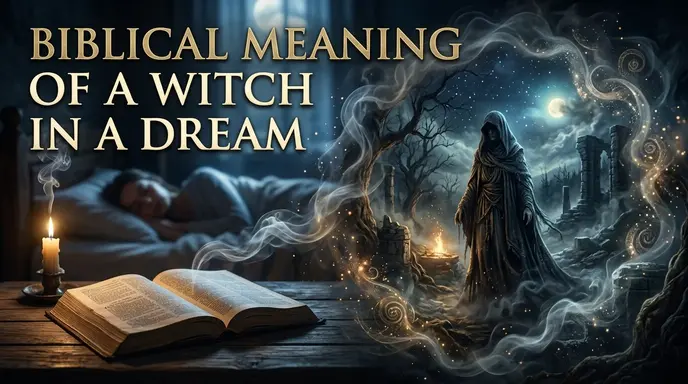
Have you ever dreamed about a witch and woken up feeling afraid, confused, or wondering whether the dream carried a spiritual message?
Dreams like these can leave you thinking about their meaning long after you wake up.
The biblical meaning of a witch in a dream is not directly defined in Scripture. However, the Bible discusses witchcraft, deception, fear, spiritual wisdom, and the importance of trusting God.
These teachings can help Christians reflect on such dreams without jumping to frightening conclusions.
A witch in a dream might remind you of a fear, a troubling experience, or something you are trying to understand. Yet the dream alone cannot prove that someone is working against you or that God is warning you about a specific person.
In this guide, we will explore relevant Bible verses, historical context, possible spiritual lessons, and practical ways to respond with faith rather than fear.
Did You Know? 🔍
The King James Version uses the word witch in Deuteronomy 18:10, while several modern translations use terms such as sorcerer or practices witchcraft. The wording reflects differences in how ancient practices are translated into modern English.
What Does a Witch in a Dream Mean in the Bible? 📖
The Bible does not give a specific meaning for seeing a witch in a dream. A careful Christian interpretation should consider biblical teachings about witchcraft, fear, deception, and spiritual discernment without treating the dream as a guaranteed prophecy.
Dreaming about a witch may lead you to reflect on personal fears, difficult relationships, temptation, or your need for peace. These are possible areas for reflection, not meanings established by Scripture.
The most important question is not simply what the witch represents, but how you can respond in a way that honors God. Pray for wisdom, examine your feelings honestly, and use Scripture as your guide.
Biblical Meaning of a Witch in a Dream ✨
Hebrew Meaning of Witchcraft
The Old Testament uses Hebrew words associated with sorcery and forbidden spiritual practices. One relevant word is kashaph, a verb associated with practicing sorcery. Related forms appear in passages such as Exodus 22:18 and Deuteronomy 18:10.
These passages address actual practices, not the appearance of a witch in someone’s dream. Therefore, the Hebrew background can explain what the Bible teaches about witchcraft, but it cannot establish a universal meaning for a dream.
Greek Meaning in the New Testament
In Galatians 5:20, the Greek word pharmakeia is commonly translated as “sorcery” or “witchcraft,” depending on the Bible translation.
The word is associated with sorcery in its biblical context. Its historical relationship to words about drugs and potions should not be taken to mean that ordinary medicine is witchcraft.
Paul includes sorcery among behaviors that conflict with a life guided by the Holy Spirit. This teaching concerns actions and spiritual priorities rather than dreams themselves.
Literal Meaning of Seeing a Witch
At the simplest level, seeing a witch in a dream means that you experienced that image while dreaming. It does not automatically mean you encountered a supernatural being or received a message from God.
Dreams can contain disturbing images, familiar fears, and unusual stories. Christians can reflect on them thoughtfully while recognizing that Scripture does not provide a fixed dictionary of dream symbols.
Spiritual Meaning and Biblical Significance
Some Christians may use a dream about a witch as an opportunity to reflect on fear, temptation, unhealthy influences, or their relationship with God.
For example, if the dream leaves you feeling unsettled, you might consider whether something in your waking life is causing stress. If you have been thinking about spiritual matters, you may wish to study what Scripture says about discernment and faithful living.
These reflections can be useful, but they should not be presented as God’s confirmed interpretation of your dream.
Read More: Tristen Name Meaning in the Bible: ExplainedHistorical and Biblical Context 🏺
Witchcraft in the Old Testament
In ancient Israel, witchcraft, divination, and consulting mediums were prohibited because they involved seeking spiritual power or guidance through practices forbidden by God.
Deuteronomy 18:10–12 lists several such practices. Leviticus 19:31 also warns the Israelites against seeking mediums and spiritists.
These commands belonged to Israel’s covenant and religious life. They show the seriousness with which Scripture treats occult practices, but they do not say that dreaming about a witch is itself a sin.
Witchcraft in the New Testament
The New Testament continues to warn against sorcery. Galatians 5:19–21 includes it among the works of the flesh, while Acts 19:18–20 describes people in Ephesus who openly confessed their former practices and gave up their magical arts.
The emphasis is on choices, beliefs, and conduct. A person who has an unwanted dream has not thereby chosen to practice witchcraft.
Understanding Ancient Beliefs
People in the ancient world often sought supernatural explanations for illness, danger, the future, and other uncertain events. Biblical laws challenged practices that competed with trust in the Lord.
This background helps readers understand why witchcraft appears in Scripture. It also reminds us not to confuse ancient religious practices with every modern image of a witch or every dream involving one.
Is a Witch Mentioned in the Bible? 📜
Yes. The King James Version uses the word witch in several passages, including Exodus 22:18 and Deuteronomy 18:10. Other translations may use sorceress, sorcerer, or related terms.
These passages refer to practices associated with sorcery, not to dream symbols. The Bible does not contain a direct teaching that seeing a witch in a dream means a curse, an attack, or a warning about a particular person.
The distinction matters because a biblical interpretation should begin with what a passage actually says. It should not turn a modern dream theory into a scriptural promise or prediction.
Spiritual Meaning and Symbolism of a Witch in a Dream 🕊️
The following are possible personal reflections, not official biblical definitions of dream symbols.
1. Fear and Anxiety
If the dream frightened you, consider whether you have been facing uncertainty, conflict, or stress. The image may give you an opportunity to acknowledge those feelings and seek peace.
Psalm 56:3 expresses trust in God when fear arises. Its lesson is to turn toward God in difficult moments, not to assume that every frightening dream predicts danger.
2. Deception and Discernment
A witch may bring to mind deception or hidden motives because of familiar cultural associations. You can use that association as a reason to reflect on honesty and wisdom.
However, a dream is not evidence that a friend, relative, or neighbor is deceiving you. Judge real situations by facts, actions, and wise counsel rather than by dream imagery alone.
3. Temptation and Spiritual Choices
Biblical passages about witchcraft encourage Christians to consider where they seek guidance and place their trust. If the dream prompts you to examine your spiritual priorities, you can respond through prayer and Bible study.
The lesson is about faithful choices, not fear of an image.
4. A Desire for Spiritual Protection
A disturbing dream may leave you longing for reassurance. Reading Scripture, praying, and talking with a trusted Christian can help you regain a sense of peace.
These practices do not require you to believe that a supernatural attack has occurred. You can seek God’s comfort without assuming the worst.
5. An Invitation to Examine Your Thoughts
Dreams can encourage personal reflection, but reflection is different from prophecy. Consider what you have been experiencing, what emotions the dream brought up, and whether any practical concern needs attention.
Ask God for wisdom while remaining open to the possibility that the dream has no special spiritual meaning.
Biblical Verses Related to Witchcraft, Dreams, and Fear 🙏
The following verses provide biblical principles for reflection. None offers a direct interpretation of a witch appearing in a dream.
1. Deuteronomy 18:10–12 — Avoid Forbidden Spiritual Practices
This passage prohibits practices such as divination, sorcery, and consulting mediums. Its purpose is to guide Israel away from spiritual practices that conflicted with worship of the Lord.
Practical lesson: Seek guidance through Scripture, prayer, and wise counsel rather than occult practices. Do not interpret the verse as proof that an unwanted dream makes you guilty of witchcraft.
2. Exodus 22:18 — A Warning Against Sorcery
In the King James Version, this verse reads, “Thou shalt not suffer a witch to live.” Modern translations often use sorceress instead.
The verse belongs to the legal material given to ancient Israel. Its severe civil penalty must be understood within that historical setting, not applied as permission for private individuals to harm or accuse anyone.
Practical lesson: Recognize the Bible’s serious position on sorcery without using the verse to justify fear or hostility toward people.
3. Galatians 5:19–23 — Choose a Life Guided by the Spirit
Paul contrasts sinful behavior, including sorcery, with the fruit of the Spirit: love, joy, peace, patience, kindness, goodness, faithfulness, gentleness, and self-control.
The passage directs attention toward the character and conduct of believers. It does not say that a frightening dream reveals someone’s spiritual condition.
Practical lesson: Let your response to uncertainty reflect love, peace, patience, and self-control rather than suspicion.
4. Psalm 56:3 — Trust God When You Are Afraid
Psalm 56:3 says, “What time I am afraid, I will trust in thee” in the King James Version.
The psalm expresses confidence in God amid distress. It does not promise that believers will never experience fear. Instead, it shows that fear can become an occasion to turn toward God.
Practical lesson: If a dream leaves you frightened, pray honestly and remind yourself of God’s care. You do not need to treat the dream as a prediction.
5. 2 Timothy 1:7 — Remember God’s Gifts
This verse describes God as giving a spirit of power, love, and a sound mind rather than fear, in the King James Version.
Christians interpret this encouragement as a call to live with courage, love, and sound judgment. It is not a guarantee that every anxious feeling will disappear immediately.
Practical lesson: Respond calmly. Seek spiritual support and practical help if fear continues to affect your sleep or daily life.
6. James 1:5 — Ask God for Wisdom
James teaches that anyone who lacks wisdom can ask God, who gives generously.
This is especially helpful when you are unsure what to make of an unusual dream. Instead of rushing to an online interpretation, you can ask for wisdom to understand your feelings and decide what deserves attention.
Practical lesson: Pray for discernment, read Scripture in context, and seek mature counsel when needed.
7. 1 John 4:1 — Test Spiritual Claims
This verse tells believers not to believe every spirit but to test the spirits. In context, John addresses claims about spiritual truth and false prophets.
The principle encourages careful discernment. It does not mean every dream must contain a hidden spiritual message.
Practical lesson: Be cautious when someone claims to know exactly what your dream means or insists that it proves a curse or attack.
8. Proverbs 3:5–6 — Trust in the Lord
These verses encourage trust in the Lord rather than relying entirely on one’s own understanding.
A dream can feel powerful, but its emotional impact does not establish its meaning. Christians can acknowledge their uncertainty while continuing to make wise, responsible choices.
Practical lesson: Do not base major decisions or accusations on a dream alone. Seek wisdom and consider the facts.
9. Philippians 4:6–7 — Bring Your Worries to God
Paul encourages believers to bring their concerns to God through prayer and thanksgiving. He connects this practice with the peace of God guarding their hearts and minds.
This passage can be comforting after a disturbing dream. It invites you to express your worries rather than allowing them to control your thoughts.
Practical lesson: Pray about what troubles you, take practical steps to address real concerns, and give yourself time to settle.
10. Ecclesiastes 5:3, 7 — Be Careful About Dreams
Ecclesiastes connects dreams with many concerns and words, and warns against empty speech. The passage is part of a wider reflection on approaching God with reverence.
It cautions readers against assuming that every dream or many words carry deep spiritual authority. It does not establish a universal rule for interpreting dream symbols.
Practical lesson: Approach dreams humbly. Avoid confident predictions when Scripture does not provide a clear interpretation.
A Biblical Case Study: Saul and the Medium of Endor 📚
First Samuel 28:3–25 describes King Saul seeking a medium at Endor when he felt distressed about the Philistine army and could not obtain guidance in the way he wanted.
Saul’s actions violated the very spiritual boundaries he had previously supported. The story shows the danger of turning to forbidden practices when fear and uncertainty become overwhelming.
This narrative is relevant to the topic because it highlights a choice: where should someone turn when they feel afraid and need guidance?
However, the account is not a dream interpretation guide. Saul visited a medium while awake; he did not simply dream about a witch.
The lesson for Christians: Do not let fear push you toward occult practices or people who claim supernatural certainty. Seek God’s guidance through Scripture, prayer, and trustworthy counsel.
Life Lessons for Christians 🌱
1. Respond With Prayer, Not Panic
A frightening dream does not automatically mean something bad will happen. Take a quiet moment to pray and reflect instead of assuming that you are in danger.
2. Avoid Accusing Other People
Never use a dream as proof that a person practices witchcraft, intends harm, or has placed a curse on you. Such accusations can damage relationships and cause real harm.
3. Study Scripture in Context
Read the full passage rather than relying on a single verse or a dramatic online interpretation. The Bible’s teachings about witchcraft and its teachings about dreams address related but different subjects.
4. Seek Support When Fear Persists
If repeated nightmares are affecting your sleep or daily life, consider speaking with a healthcare professional as well as a trusted spiritual adviser. Caring for your well-being is compatible with Christian faith.
Common Misunderstandings About Witch Dreams ⚠️
Misunderstanding 1: A witch in a dream always means a spiritual attack.
Scripture does not establish this rule. A dream alone cannot confirm a spiritual attack.
Misunderstanding 2: The dream proves that someone has cursed you.
There is no biblical basis for identifying a person as responsible for harm simply because you dreamed about a witch.
Misunderstanding 3: Every dream contains a message from God.
The Bible includes accounts in which God communicates through dreams, but it does not say that every dream is a divine message. Context and discernment matter.
Misunderstanding 4: Having the dream is a sin.
An unwanted dream is not the same as deliberately practicing witchcraft. The biblical passages about sorcery address prohibited practices, not the mere experience of a dream.
Misunderstanding 5: Every witch dream has one fixed meaning.
Popular interpretations often assign specific meanings to dream images. Such interpretations should not be presented as established biblical teaching when Scripture does not confirm them.
Expert Insight: How to Interpret a Witch Dream Carefully 💡
Use a simple three-step approach:
- Describe the dream: Write down what happened and how you felt without immediately deciding what it means.
- Compare it with Scripture: Identify relevant biblical principles, such as wisdom, trust, discernment, and avoiding occult practices.
- Avoid unsupported conclusions: Do not declare the dream a prophecy, a curse, or evidence against another person.
Remember that a biblical principle can guide your response without revealing the exact cause or meaning of the dream.
FAQs ❓
What does seeing a witch in a dream mean spiritually?
Scripture gives no fixed meaning for this image. You may reflect on fear, uncertainty, or spiritual priorities without assuming the dream predicts danger.
Is seeing a witch in a dream a warning from God?
Not necessarily. The Bible records meaningful dreams, but it does not teach that every dream is a divine warning or prophecy.
Does dreaming about a witch mean someone is doing witchcraft against me?
No. A dream cannot establish that another person practices witchcraft or intends to harm you. Avoid accusations without reliable evidence.
What should I pray after dreaming about a witch?
Ask God for wisdom, peace, and discernment. You can pray using James 1:5 and Psalm 56:3 while remembering that the dream may have no special spiritual meaning.
Is dreaming about a witch a sin?
No biblical passage says that merely dreaming about a witch is a sin. Scripture’s warnings concern occult practices and other deliberate actions, not an unwanted dream.
Conclusion:
The biblical meaning of a witch in a dream is not directly explained in Scripture. Although the Bible clearly warns against witchcraft and forbidden spiritual practices, it does not say that seeing a witch in a dream proves a curse, spiritual attack, or divine warning.
Instead of allowing fear to guide your interpretation, turn to biblical principles of prayer, wisdom, discernment, and trust in God. Consider your feelings honestly, study relevant verses in context, and avoid accusing anyone based on a dream.
Remember that you do not need to understand every dream to live faithfully. If the experience has unsettled you, ask God for peace and seek wise support when needed.
Let your faith be guided by God’s Word rather than fear or speculation. A disturbing dream does not have to control your thoughts or take away your peace.

I am Rebecca Collins, a Christian writer and Bible researcher at BibleMeaningHub.com. I share insightful biblical interpretations and faith-based teachings to help readers better understand Scripture. My mission is to encourage spiritual growth and strengthen faith through God’s Word.








1 thought on “Biblical Meaning of a Witch in a Dream: A Bible Guide”