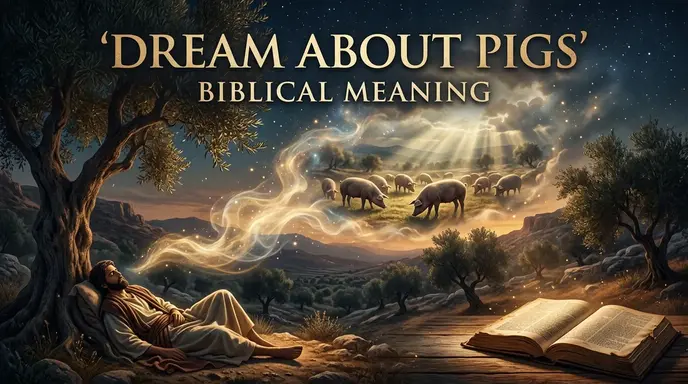
Have you ever dreamed about pigs and wondered whether the dream carries a spiritual message?
Perhaps you saw a pig walking through your house, a muddy pig, a herd of pigs, or a pig chasing you. Such a dream can leave you curious, confused, or even worried about its meaning.
The dream about pigs biblical meaning is best explored by looking at how pigs appear in Scripture and what lessons those passages teach.
In the Old Testament, pigs were considered unclean under Israel’s dietary laws. In the New Testament, they appear in stories that touch on suffering, repentance, and spiritual warnings.
However, the Bible does not assign one fixed meaning to every pig dream. Your dream is not automatically a warning from God, a prediction of trouble, or proof of spiritual attack.
A thoughtful Christian approach begins with Scripture, prayer, and an honest look at your circumstances.
🔍 Did You Know?
Leviticus 11:7 describes the pig as having a divided hoof but not chewing the cud. This made it unclean under the dietary laws given to ancient Israel. The same instruction appears in Deuteronomy 14:8.
This historical detail helps explain why pigs can carry associations with uncleanness in biblical discussions. It does not, by itself, establish what a modern dream means.
📖 What Does Dreaming About Pigs Mean in the Bible?
Dreaming about pigs has no single, directly stated biblical interpretation. Because Scripture associates pigs with ceremonial uncleanness in the Old Testament and uses them in several New Testament passages, some Christians reflect on themes such as purity, harmful habits, repentance, and spiritual discernment. These are possible reflections, not guaranteed meanings or divine predictions.
To understand your dream responsibly, consider what happened in it, how you felt, and whether a relevant biblical passage speaks to a real situation in your life.
🐖 Biblical Meaning of Pigs in Dreams
Hebrew meaning of pigs
The Hebrew Bible uses the word chazir (חֲזִיר) for a pig or swine. The term appears in passages about animals that Israelites were not permitted to eat under the Mosaic Law.
Leviticus 11:7–8 explains the pig’s classification as unclean. This is a matter of biblical dietary law, not a direct explanation of dream symbols.
If you are researching the Hebrew meaning of pigs in dreams, keep these two things separate: the word’s actual meaning in Scripture and the personal significance you might attach to a dream.
Greek meaning of pigs
In the Greek New Testament, the word choiros (χοῖρος) refers to a pig or swine. It appears in passages such as Matthew 8:30–32 and Luke 15:15–16.
These passages use pigs in real narrative settings. Jesus encounters a herd of pigs during an act of deliverance, while the parable of the lost son describes a young man feeding pigs after losing his wealth.
The Greek word itself does not mean bad luck, financial loss, or a spiritual attack.
Literal meaning versus spiritual meaning
A literal dream about pigs simply involves pigs appearing in your dream. A spiritual interpretation looks for a possible connection between the dream and your beliefs, choices, emotions, or current concerns.
For example, someone struggling with a harmful habit might reflect on the Bible’s warning against returning to destructive behavior. Someone feeling ashamed might find hope in the story of the lost son.
Neither example proves that the dream was sent by God. They show how biblical teachings can help you reflect without treating every dream as a supernatural message.
Biblical significance of pigs
Pigs have several different roles in Scripture:
- Unclean animals: Leviticus 11:7–8 and Deuteronomy 14:8 describe the dietary restrictions given to Israel.
- A setting for deliverance: Mark 5:1–20 describes Jesus freeing a suffering man.
- A picture of hardship: Luke 15:11–32 places the lost son among pigs during his lowest point.
- A warning about returning to harmful ways: 2 Peter 2:22 uses the image of a washed sow returning to mud.
These passages provide useful biblical themes, but none gives a universal interpretation of dreaming about pigs.
Key Scripture reference
Leviticus 11:7 is a key reference because it explains why pigs were considered unclean under the law given to Israel. For Christian dream interpretation, however, it is important to read this verse in context rather than assume that a pig in a dream means sin or impurity.
The New Testament also discusses food and ceremonial cleanliness. Mark 7:18–19 and Acts 10:9–16 are important passages to study when considering how Christians understand these Old Testament dietary laws.
Read More: What Does My Name Mean Spiritually? A Biblical Perspective🏺 Historical and Biblical Context of Pigs
Old Testament usage
In the Old Testament, pigs were classified as unclean animals under the dietary laws given to the Israelites. Leviticus 11:1–8 explains which land animals could be eaten, and Deuteronomy 14:3–8 repeats these instructions.
These rules belonged to Israel’s covenant life and helped distinguish the community in its worship and daily practices. The biblical meaning of an unclean animal in this setting should not be confused with a claim that the animal itself is evil.
When considering a dream, this context may prompt reflection on obedience, holiness, and the importance of understanding God’s instructions. It does not establish that the dream is a warning.
New Testament relevance
Pigs appear in several New Testament accounts. In Mark 5:1–20, Jesus delivers a man from torment, and the spirits enter a nearby herd of pigs. In Luke 15:11–32, the lost son finds himself feeding pigs after wasting his inheritance.
These stories have different purposes. The first highlights Jesus’ authority and the man’s deliverance. The second describes the son’s desperate condition before he returns to his father.
A dream featuring pigs may remind a Christian of one of these stories, but the story that comes to mind does not automatically reveal the dream’s meaning.
Cultural understanding in biblical times
For ancient Israelites, pigs were associated with food restrictions under the law. In other communities, pigs could be raised for food and trade. Their appearance in biblical stories therefore reflects both everyday life and the religious setting of the people involved.
Understanding this background helps avoid reading modern ideas about dreams into ancient Scripture. Biblical interpretation begins with what a passage meant in its original context before considering how its lessons may apply today.
❓ Is Dreaming About Pigs Mentioned in the Bible?
The Bible mentions pigs in several passages, but it does not give a specific interpretation for the modern experience of dreaming about them.
Scripture does describe dreams in which God communicates with people. For example, Joseph interprets dreams in Genesis 40, and Daniel explains Nebuchadnezzar’s dream in Daniel 2. These accounts show that God used dreams on certain occasions in biblical history. They do not mean that every dream comes from God or that every symbol has a hidden spiritual message.
If you dream about pigs, consider these questions:
- Does a relevant Bible passage speak to something you are facing?
- Is the dream connected to a recent experience or worry?
- Does your interpretation agree with the broader teaching of Scripture?
- Are you responding with wisdom and peace, or with fear and speculation?
The most trustworthy approach is to avoid making major decisions based only on a dream.
✨ Spiritual Meaning and Symbolism of Pigs in Dreams
The following are possible reflections inspired by biblical themes. They are not fixed biblical interpretations.
1. A reminder to examine your choices
Because pigs appear in passages about uncleanness, some Christians may use a pig dream as an opportunity to examine their habits and decisions.
Ask yourself whether there is an area of life where you want to grow in honesty, self-control, or obedience to God. Let Scripture guide that reflection rather than assuming that the dream proves you have sinned.
2. A reflection on harmful habits
Second Peter 2:22 uses the picture of a washed sow returning to the mud as part of a warning about returning to corruption. A dream involving a pig returning to mud might remind you of the struggle to leave an unhealthy pattern behind.
Still, the dream does not prove that you are trapped in sin. You can use the image as a prompt to seek support, practice self-control, and rely on God’s grace.
3. A reminder of repentance and hope
In Luke 15, the lost son reaches a point of deep hardship while feeding pigs. He then recognizes his situation, returns to his father, and is welcomed home.
If your dream brings feelings of shame or regret, this story offers a hopeful lesson. You can acknowledge mistakes and seek a better path. The father’s welcome in the parable reminds readers of the importance of mercy and restoration.
4. A call to spiritual discernment
A striking dream can feel meaningful, but feelings alone cannot confirm its source. First Thessalonians 5:21 encourages believers to test things carefully and hold on to what is good.
Rather than assuming the dream predicts danger, compare your thoughts with Scripture. Seek wise Christian counsel if you remain troubled, and do not let an uncertain interpretation control your decisions.
⚖️ Comparison Table: Pig Dreams and Biblical Themes
| Dream image | Possible reflection | Biblical connection |
| A pig in mud | Examining habits or choices | 2 Peter 2:22 |
| A pig in a house | Reflecting on home life or personal concerns | No direct biblical dream interpretation |
| A pig chasing you | Considering fear or conflict | No direct biblical dream interpretation |
| A herd of pigs | Reflecting on a story or current concern | Mark 5:11–13 |
| Feeding pigs | Thinking about hardship or feeling stuck | Luke 15:15–16 |
| A clean pig | Considering personal change or renewal | No direct biblical dream interpretation |
| A dead pig | Reflecting on loss or change | No fixed biblical meaning |
Remember: The possible reflections in this table are suggestions for personal thought, not biblical promises or predictions. The Bible does not assign a confirmed meaning to each dream image.
📚Biblical Verses to Study When You Dream About Pigs
The following passages provide a scriptural foundation for reflecting on pig dreams. Some mention pigs directly; others help Christians approach dreams with wisdom. They should be read in context rather than treated as a codebook for predicting the future.
1. Leviticus 11:7–8 — Pigs and ceremonial uncleanness
These verses classify pigs as unclean under the dietary laws given to Israel. They explain the animal’s place within the Old Testament system of clean and unclean animals.
Practical lesson: If a pig dream makes you think about purity or obedience, use that thought to examine your choices prayerfully. Do not assume that seeing a pig makes you spiritually unclean. The passage addresses dietary law, not the meaning of a dream.
2. Deuteronomy 14:8 — Following God’s instructions
Deuteronomy repeats the restriction concerning pigs and places it within a broader list of dietary instructions. This shows that the rule was part of Israel’s covenant practice rather than an isolated statement about the animal.
Practical lesson: Study the context before applying a verse to your life. Christians can learn from the Old Testament’s emphasis on faithful living while recognizing that food laws are understood differently under the New Testament.
3. Mark 5:11–13 — Jesus and the herd of pigs
In this account, a herd of pigs is nearby when Jesus frees a man suffering under the power of unclean spirits. The spirits enter the pigs, and the herd rushes into the sea.
Practical lesson: The central focus is Jesus’ authority and the man’s deliverance, not a formula for interpreting dreams. If the story comes to mind after your dream, reflect on Christ’s power to bring freedom and hope rather than assuming a spiritual attack.
4. Luke 15:15–16 — The lost son among pigs
The younger son in Jesus’ parable becomes so desperate that he feeds pigs and longs to eat their food. His situation illustrates how far he has fallen after wasting his inheritance.
Practical lesson: Hard times do not have to define your future. If the dream reminds you of regret or failure, consider the next part of the parable: the son recognizes his condition and returns to his father. Repentance and restoration remain central themes.
5. 2 Peter 2:22 — Returning to harmful ways
This verse uses vivid animal imagery to warn about returning to corruption after knowing the right path. The picture of a washed sow returning to mud reinforces the warning.
Practical lesson: Consider whether a habit you have worked to change needs further attention. Do not use the verse to condemn yourself because of a dream. Instead, seek practical support and make choices that help you grow.
6. Genesis 40:8 — Seeking understanding of dreams
Joseph tells the men whose dreams he encounters that interpretations belong to God. In the surrounding passage, their dreams are interpreted within a specific biblical narrative.
Practical lesson: This story encourages humility when considering dreams. It does not authorize everyone to claim that they can decode every symbol. Ask God for wisdom, and be careful about accepting confident interpretations that lack scriptural support.
7. Ecclesiastes 5:3 — Dreams and daily concerns
Ecclesiastes connects dreams with much activity and human concerns. The verse reminds readers that dreams can arise amid the many things occupying the mind.
Practical lesson: A dream about pigs may reflect something you recently saw, heard, worried about, or experienced. You do not need to assume that every vivid dream contains a divine message. Reflect calmly and avoid fear-based conclusions.
8. 1 Thessalonians 5:21 — Test everything carefully
Paul encourages believers to examine things carefully and hold on to what is good. This principle is useful when considering claims about spiritual experiences.
Practical lesson: If someone tells you that a pig dream definitely means betrayal, financial loss, or a curse, ask where Scripture actually teaches that interpretation. You can take your spiritual life seriously without accepting unsupported claims.
🧑🌾 A Real-Life Biblical Case Study: The Lost Son
One of the most useful biblical stories for reflecting on pigs is Jesus’ parable of the lost son in Luke 15:11–32.
A younger son asks his father for his inheritance and leaves home. He wastes his money and eventually faces severe hardship. He takes a job feeding pigs and becomes so hungry that their food looks appealing.
Then he recognizes his situation. He decides to return home and admit his wrongdoing. Instead of rejecting him, his father welcomes him with compassion and celebrates his return.
The story does not teach that dreaming about pigs means you have wandered away from God. Its message is about repentance, mercy, and restoration.
The lesson for Christians: Whatever your dream brings to mind, remember that failure does not have to be the end of your story. You can seek forgiveness, make better choices, and return to a closer walk with God.
🙏 Life Lessons for Christians
1. Seek wisdom before interpreting a dream
Pray for wisdom and read Scripture carefully. Avoid making a quick judgment about your dream based on a single symbol or an online interpretation.
2. Examine your life without condemning yourself
If the dream reminds you of a harmful habit, consider what changes might help. Honest self-examination can be useful, but a dream is not proof that God is displeased with you.
3. Remember God’s grace
The lost son’s story reminds Christians that repentance and restoration are possible. Even when you regret past choices, you can seek forgiveness and work toward a healthier future.
4. Choose faith over fear
Do not assume a pig dream predicts death, poverty, betrayal, or spiritual danger. The Bible does not establish these meanings. Focus instead on prayer, wise decisions, and the teachings of Jesus.
⚠️ Common Misunderstandings About Pig Dreams
Misunderstanding 1: Every pig dream is a warning from God.
The Bible does not teach this. Dreams can have different causes, and Scripture does not provide a universal interpretation for them.
Misunderstanding 2: A pig in a dream proves that someone is evil.
Biblical references to pigs do not establish that a person who appears in a pig-related dream is wicked or dangerous. Avoid judging other people based on a dream.
Misunderstanding 3: Dreaming about pigs means financial loss is coming.
No biblical passage establishes this prediction. Do not make financial or personal decisions based on unsupported dream symbolism.
Misunderstanding 4: Pigs always represent demons or spiritual attacks.
Although pigs appear in the deliverance account in Mark 5, that story does not make every pig dream evidence of demonic activity.
Misunderstanding 5: The Old Testament food laws mean Christians must avoid pigs in every context.
Leviticus 11 describes dietary rules given to Israel. New Testament passages, including Mark 7:18–19 and Acts 10:9–16, are important for understanding how Christians interpret these laws. Ceremonial dietary restrictions should not be confused with the broader call to holy living.
💡 Expert Insight: How to Interpret a Pig Dream Responsibly
Use a simple three-step approach.
- Describe the dream: Write down what happened and how you felt without adding assumptions.
- Study the relevant passage: Read the full biblical story, not just one verse mentioning pigs.
- Consider the application: Ask whether a clear biblical lesson applies to your life. Do not treat a possible connection as a guaranteed message from God.
Reliable interpretation begins with Scripture’s actual meaning. A dream may prompt reflection, but it should not replace biblical teaching, sound judgment, or wise counsel.
❓FAQs
1. What does dreaming about pigs mean spiritually?
It may prompt reflection on habits, repentance, or spiritual growth, but the Bible does not establish one fixed spiritual meaning for pig dreams.
2. Is dreaming about pigs a bad sign in Christianity?
No biblical passage says that dreaming about pigs is automatically a bad sign. Avoid assuming that the dream predicts trouble or divine punishment.
3. What does a dirty pig mean in a dream biblically?
Some Christians may associate mud with the imagery in 2 Peter 2:22, but Scripture does not directly interpret dirty pigs in dreams.
4. What does it mean to dream about a pig chasing you?
The Bible gives no specific interpretation for this dream. You might reflect on feelings of fear or pressure without treating them as a prophecy.
5. Can God speak through dreams about pigs?
The Bible records occasions when God communicated through dreams. However, it does not establish that every dream about pigs comes from God.
🌿 Conclusion:
The dream about pigs biblical meaning is best understood by examining Scripture rather than relying on fixed dream symbols.
In the Bible, pigs appear in discussions of ceremonial uncleanness, Jesus’ ministry, the parable of the lost son, and warnings about returning to harmful ways.
These passages offer lessons about obedience, spiritual discernment, repentance, and God’s mercy. However, none establishes that dreaming about pigs predicts misfortune or proves that God is sending you a warning.
If you have experienced this dream, take time to reflect, pray for wisdom, and read the relevant Bible passages in context.
Consider whether there is a practical lesson you can apply, but do not let fear guide your decisions.
Remember: Your dream does not define your relationship with God. Keep your focus on Scripture, trust in God’s grace, and continue seeking a life shaped by faith, wisdom, and love.











1 thought on “Dream About Pigs Biblical Meaning: What Does It Mean?”