Most people have heard that 13 is an unlucky number. Many hotels skip the 13th floor, and some people even fear Friday the 13th. But is this belief found in the Bible?
If you’re wondering about the number 13 meaning in the Bible, you’re not alone. The Bible doesn’t teach luck or superstition, but it does use numbers to reveal important spiritual truths.
In this article, you’ll discover where the number 13 appears in Scripture, what it symbolizes, and what lessons believers can learn from it.
Quick Answer – What Is the Number 13 Meaning in the Bible?
In the Bible, the number 13 is most commonly associated with rebellion, corruption, and opposition to God’s order. It first appears in Genesis 14:4 linked to a revolt. However, Scripture also connects 13 to transformation, as God sometimes works powerfully through what the world considers cursed or broken. It carries both a warning and a redemptive thread.
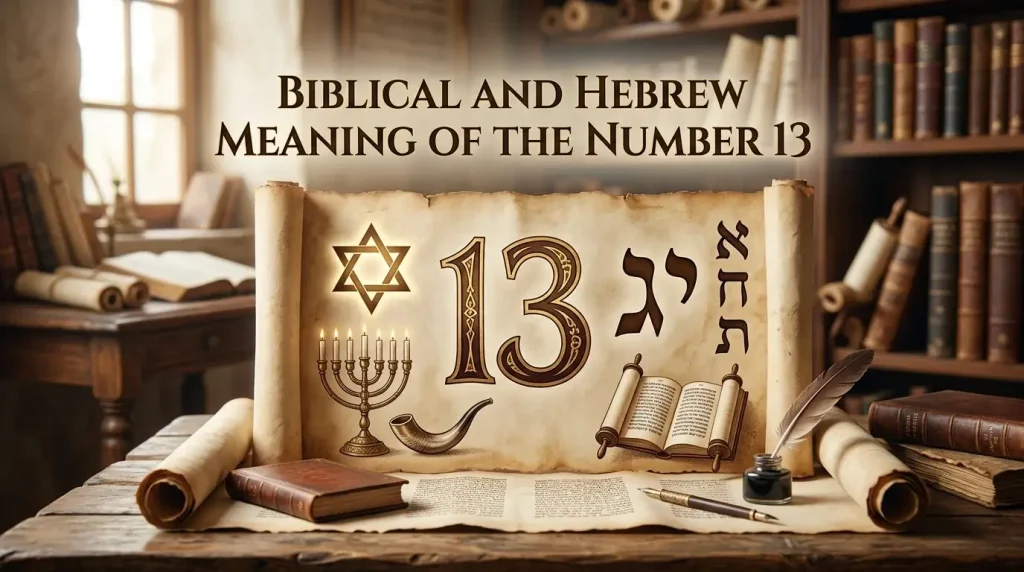
Biblical and Hebrew Meaning of the Number 13📖
Numbers in the Bible are never accidental. God wove meaning into the very structure of Scripture — and Hebrew culture understood this deeply.
The Hebrew Understanding of Numbers
In Hebrew tradition, numbers carry spiritual and symbolic weight that goes far beyond their mathematical value. This study is called gematria the assigning of numerical value to letters and words. While Christians should not build doctrine on numerology alone, understanding the pattern of how numbers appear in Scripture is a legitimate and enriching part of Bible study.
The number 13 in Hebrew is written as shelosh esreh (שְׁלֹשׁ עֶשְׂרֵה). In many biblical patterns, the number 12 represents divine order and government — 12 groups of Israel, 12 apostles, 12 gates of the New Jerusalem. The number 13, coming directly after 12, has been interpreted by many Bible scholars as a departure from that divine order — a symbol of rebellion, lawlessness, and the disruption of God’s perfect design.
Literal and Spiritual Meaning
Literally, 13 is simply the number that follows 12. But spiritually, it carries a recurring association with defiance against God and His appointed authority. From the first rebellious king Nimrod to the rebellion of the 13 kings in Genesis, this pattern holds steady across the Old and New Testaments.
Yet God’s grace is always greater than human rebellion. And that is the deeper spiritual truth — even where 13 signals brokenness, God’s redemption is never far behind.
Historical and Biblical Context of the Number 13🏛️
Old Testament Appearances
The number 13 meaning in the Bible shows up with unmistakable clarity in the very first book of Scripture.
Genesis 14:4 gives us the first explicit use: “For twelve years they had served Chedorlaomer, but in the thirteenth year they rebelled.” This is striking — 12 years of submission, then rebellion in year 13. The pattern of 12 representing order and 13 representing defiance is established right here.
Nimrod, widely considered the Bible’s first great rebel against God, is described in Genesis 10. He is the 13th descendant of Ham, one of Noah’s sons. Nimrod built Babel — the original tower of human pride and defiance against God’s authority. The connection of his lineage number to his character is spiritually significant.
Ishmael was 13 years old when he was circumcised (Genesis 17:25). While Ishmael was not rejected by God — God blessed him — this age marker points to a moment of transition and covenant testing.
The 13 Attributes of God’s Mercy — In Jewish tradition, Exodus 34:6–7 is known as the Thirteen Attributes of Mercy (the Shelosh Esreh Middot). God revealed these to Moses after the golden calf rebellion. Remarkably, God chose to respond to Israel’s greatest act of rebellion with a 13-fold declaration of His grace. This is perhaps the most beautiful biblical reversal of the number 13 — God transforms the number of rebellion into a declaration of mercy.
New Testament Relevance
In the New Testament, the number 13 does not appear as explicitly, but its shadow is present. Judas Iscariot was the 13th member of Jesus’s inner circle — Jesus plus the 12 apostles. When Judas betrayed Jesus, he embodied the theme of defection and rebellion that has accompanied the number 13 throughout Scripture.
Paul’s list of sins in Romans 1:29–31 contains exactly 13 specific sins, including wickedness, greed, envy, murder, and rebellion against parents. Some scholars count these deliberately, seeing a connection to the biblical pattern of 13 as a number of lawlessness.
Cultural Understanding in Biblical Times
In the ancient world, numbers were deeply symbolic — not superstitious in the modern sense, but intentionally loaded with meaning. Biblical authors wrote under the inspiration of the Holy Spirit but within a culture that understood numerical patterns as part of God’s design in creation.
The number 13 was never considered “bad luck” in the modern sense in biblical times. Rather, it was understood within the framework of covenant — a reminder that departing from God’s order (represented by 12) always leads to trouble. It was a warning embedded in creation’s design, not a superstition.
Where Does the Number 13 Appear in the Bible?🔍
The number 13 appears at key moments throughout Scripture. Here are some of the most significant:
- Genesis 14:4 — Thirteen years of rebellion by vassal kings against Chedorlaomer
- Genesis 17:25 — Ishmael circumcised at age 13
- Genesis 10 — Nimrod, the 13th from Ham, builds Babel in rebellion
- Exodus 34:6–7 — The 13 Attributes of God’s Mercy proclaimed after Israel’s rebellion
- 1 Kings 7:1 — Solomon took 13 years to build his own palace (compared to 7 years for God’s temple — a pointed contrast)
- Esther 3:12–13 — Haman’s decree to destroy the Jews was issued on the 13th day of the first month
- Romans 1:29–31 — Paul lists 13 characteristics of sinful rebellion
- Revelation — The number 13 is tied to the beast in prophetic imagery
Each of these appearances reinforces the consistent biblical theme: 13 marks moments where human beings depart from God’s order — and where God’s grace responds powerfully.
Spiritual Meaning and Symbolism of the Number 13🕊️
Rebellion Against God’s Order
The core spiritual meaning of 13 in the Bible is rebellion — the human tendency to reject God’s authority and go our own way. This is not a moral condemnation of anyone born on the 13th, or of the number itself. It is a spiritual pattern that Scripture reveals consistently across centuries of history.
God established 12 as the number of His government — 12 groups, 12 apostles, 12 months, 12 gates. When humans depart from that order, 13 becomes the marker of that departure. It is a mirror of the human heart turned away from God.
God’s Mercy in the Face of Rebellion
Here is where the story gets truly beautiful. The Bible’s most powerful encounter with the number 13 is not the story of Nimrod or the kings who rebelled. It is Exodus 34:6–7 — the 13 Attributes of God’s Mercy.
After Israel built the golden calf — their worst act of rebellion in the wilderness — God did not abandon them. Instead, He descended on the mountain and declared 13 qualities of His own character: compassion, grace, patience, lovingkindness, faithfulness, and more.
God took the number associated with rebellion and filled it with mercy. This is what the gospel does — it takes our worst moments and meets them with the greatest love.
Warning and Invitation
Spiritually, the number 13 functions as both a warning and an invitation. The warning is clear: departing from God’s design leads to disorder, suffering, and spiritual emptiness. The invitation is equally clear: no matter how far we have strayed, God’s mercy meets us right where we are.
God’s Perspective on Human Rebellion
God is never surprised by rebellion. From the Garden of Eden onward, He knew the human heart would wander. But He always had a plan of redemption. The cross of Jesus Christ is the ultimate answer to all human rebellion — including everything the number 13 symbolizes.
Romans 5:20 captures this perfectly: “Where sin increased, grace increased all the more.” Every act of human rebellion is met — and overwhelmed — by God’s greater grace.
Key Biblical Passages Revealing the Number 13📜
1. Genesis 14:4
“For twelve years they had served Chedorlaomer, but in the thirteenth year they rebelled.”
Explanation: This is the Bible’s first explicit use of the number 13, and it is directly connected to rebellion. After 12 years of order and submission, the 13th year brought revolt. This foundational passage sets the tone for the number’s meaning throughout all of Scripture.
Practical Lesson: When we walk outside God’s design, we invite chaos. Order under God is always better than rebellion in our own strength.
2. Genesis 17:25
“And his son Ishmael was thirteen years old when he was circumcised in the flesh of his foreskin.”
Explanation: Ishmael’s circumcision at 13 is significant. While Isaac carried the covenant promise, Ishmael was still included in the covenant sign. Yet the age of 13 marks a transition point — a moment between promise and waiting, between belonging and wandering.
Practical Lesson: God’s covenant reaches even those who seem to be on the edges of His plan. No one is beyond His reach.
3. Exodus 34:6–7
“And he passed in front of Moses, proclaiming, ‘The Lord, the Lord, the compassionate and gracious God, slow to anger, abounding in love and faithfulness, maintaining love to thousands, and forgiving wickedness, rebellion and sin…'”
Explanation: Jewish tradition counts 13 divine attributes in this passage. God spoke these words immediately after Israel’s worst act of idolatry. Instead of judgment, He chose self-revelation — declaring who He truly is. Thirteen attributes of mercy answered Israel’s rebellion.
Practical Lesson: When we expect judgment, God often surprises us with mercy. His character is always greater than our failure.
4. 1 Kings 7:1
“It took Solomon thirteen years, however, to complete the construction of his own palace.”
Explanation: Solomon spent 7 years building God’s temple and 13 years building his own palace. The contrast is intentional and sobering. The number 13 here marks excessive self-focus — a subtle but clear sign that Solomon’s priorities were beginning to drift.
Practical Lesson: When we invest more in our own comfort than in God’s purposes, we begin to walk in the spirit of spiritual disorder.
5. Esther 3:12–13
“…dispatches were sent by couriers to all the king’s provinces with the order to destroy, kill and annihilate all the Jews… on the thirteenth day of the first month.”
Explanation: Haman chose the 13th day of the month for the destruction of God’s people. It was a day marked for death and rebellion against God’s covenant community. But God reversed it completely — and the 13th became a day of Jewish survival and celebration (Purim).
Practical Lesson: What the enemy designs for destruction, God can turn into deliverance. He always has the final word.
6. Romans 1:29–31
“They have become filled with every kind of wickedness, evil, greed and depravity…”
Explanation: Paul’s list in this passage contains 13 specific sins that mark a life lived in rebellion against God. This is not coincidental — it is a picture of what humanity looks like when it fully turns away from its Creator. The list is sobering, but it also makes the grace of Romans 8 shine all the brighter.
Practical Lesson: Understanding the depth of human rebellion makes the love of God in Christ all the more breathtaking.
7. Revelation 13
“The dragon stood on the shore of the sea. And I saw a beast coming out of the sea…”
Explanation: Revelation 13 introduces the beast — the most dramatic biblical symbol of rebellion against God. The chapter itself carries the number 13, and it speaks of a final, ultimate confrontation between human rebellion empowered by Satan and the kingdom of God. It is the number of rebellion at its peak.
Practical Lesson: Human rebellion has a final chapter — and God wins. Christians live with confidence, not fear, because the end of the story is already written.
Life Lessons for Christians from the Number 13🌱
Understanding the number 13 meaning in the Bible is not just an intellectual exercise — it has real, practical implications for how we live:
1. Recognize the Pull of Rebellion
Every human heart carries the temptation to go our own way. The number 13 reminds us that rebellion is not just dramatic disobedience — it is also the slow drift away from God’s design in daily choices.
2. Trust God’s Order
The number 12 represents divine structure and wisdom. When we align our lives with God’s Word, His church, and His purposes, we walk in the blessing of His design. Departing from it always costs more than we expect.
3. Remember That Mercy Meets Rebellion
The 13 Attributes of God’s Mercy are the Bible’s greatest message about this number. No matter how far we have wandered, God’s mercy is greater. Run back to Him — He is already running toward you.
4. Don’t Fear the Number — Fear Departure from God
Christians have no reason to fear the number 13 as a superstition. The real warning is not a number — it is the posture of a heart turned away from God. Fear that. Seek Him instead.
5. Trust God’s Sovereignty Over Every “Unlucky” Season
When life feels like a “13th year” — chaotic, rebellious, broken — remember that God is still sovereign. Esther’s story happened on the 13th. And God won.
Common Misunderstandings About the Number 13 in the Bible⚠️
The Bible Says 13 Is Unlucky
The Bible never uses the language of luck at all. Scripture does not teach that any number brings good or bad fortune. The association of 13 with bad luck comes largely from medieval European superstition and has no direct biblical foundation. Christians should be careful not to import cultural superstition into biblical interpretation.
Seeing the Number 13 Is a Sign from God
Some people today treat recurring numbers as divine messages — a practice closer to numerology than biblical faith. While God can certainly use anything to speak to His people, the Bible warns against seeking signs in patterns rather than seeking God Himself through His Word and prayer (Deuteronomy 18:10–12).
The Number 13 Means Only Negative Things
This is the most common misreading. Yes, 13 is frequently associated with rebellion in Scripture — but the 13 Attributes of God’s Mercy flip this entirely. God redeemed the number 13 at Sinai when He met Israel’s worst moment with His greatest self-revelation. The number is not purely negative — it is complex, and God’s grace runs through it.
Judas Being the 13th Proves the Number Is Cursed
Judas’s betrayal was a tragedy of free will and human choice — not a predetermined outcome based on his position at the table. Jesus chose all twelve of His disciples intentionally, knowing what Judas would do. The lesson of Judas is not about the number 13 — it is about the danger of loving money more than the Messiah.
❓ FAQs
1. What is the number 13 meaning in the Bible?
In the Bible, 13 most often represents rebellion and departure from God’s divine order. It first appears in Genesis 14:4 linked to revolt.
2. Is the number 13 evil in Scripture?
Not exactly. The Bible does not label numbers as evil. Thirteen consistently marks moments of human rebellion, but God’s mercy always responds.
3. What does 13 mean spiritually for Christians?
Spiritually, 13 is a reminder that human rebellion always has consequences — but God’s grace is always greater.
4. Why is 13 considered unlucky?
The “unlucky 13” superstition comes from medieval culture, not the Bible. Some trace it to the Last Supper having 13 at the table, or to Friday the 13th folklore.
5. What are the 13 Attributes of God’s Mercy in the Bible?
Found in Exodus 34:6–7, the 13 Attributes of God’s Mercy are: Lord, Lord, God compassionate, gracious, slow to anger, abounding in love, abounding in faithfulness, maintaining love to thousands, forgiving wickedness, forgiving rebellion, forgiving sin, and yet not leaving the guilty unpunished.
✝️ Conclusion:
The number 13 in the Bible is more than a symbol of rebellion. It also reminds us of God’s amazing mercy.
Even when people turned away from Him, God responded with grace and compassion instead of giving up on them.
The message is simple: no matter how far we have wandered, God’s mercy is always greater than our failures. Trust in His grace, because He always welcomes those who return to Him.
Read More Post:
Does 222 Have a Meaning in the Bible? A Christian View
What Does Andrew Mean in the Bible? Full Explanation
Caleb Meaning in Bible: A Story of Faith and Courage

I am a Christian writer and Bible researcher passionate about making Scripture easy to understand. Through biblical meanings, Hebrew insights, and faith-based studies, I help readers grow in their knowledge of God’s Word and strengthen their walk with Christ.