Have you ever wondered if a name has a deeper meaning in the Bible? Many people ask, “What does Marie mean in the Bible?”
Marie is the French form of Mary, one of the most important names in Scripture. Although the name Marie does not appear directly in the Bible, it shares the same Hebrew roots and spiritual meaning as Mary, the mother of Jesus.
If your name is Marie, you’re choosing it for a child, or you’re simply curious about its biblical significance, this guide will help you discover its Hebrew origin, spiritual meaning, and the faith lessons connected to this beautiful name.
Quick Answer — What Does Marie Mean in the Bible?
Marie is the French form of Mary, which comes from the Hebrew name Miriam, meaning “beloved,” “bitter,” “strong,” or “wished-for child.” In the Bible, the name appears through women of extraordinary faith — most notably the Virgin Mary, mother of Jesus. It carries themes of courage, devotion, and God’s redemptive grace throughout Scripture.
Biblical and Hebrew Meaning of the Name Marie📖
The Hebrew Root: Miriam
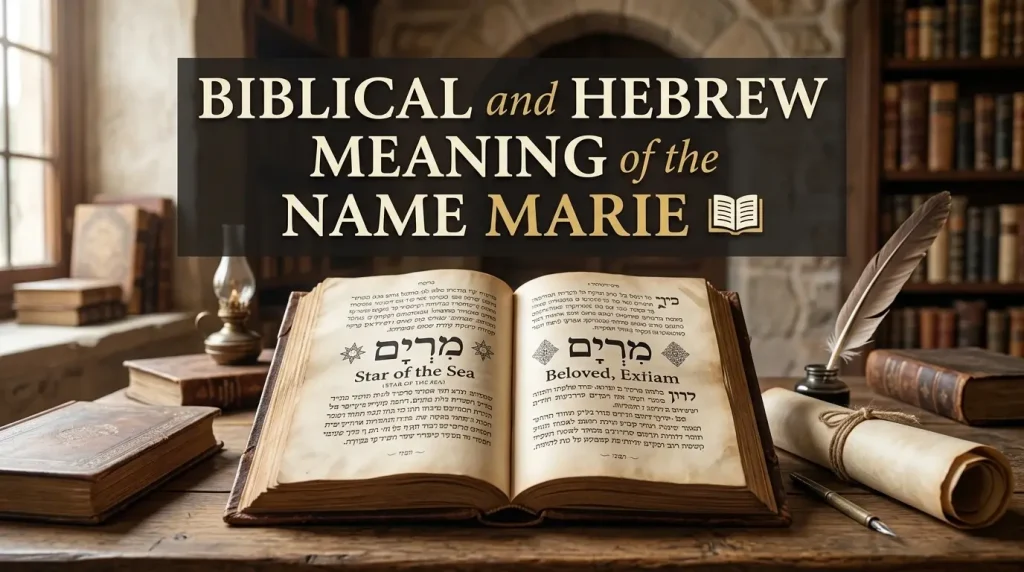
To truly understand what Marie means in the Bible, we have to go back to its original Hebrew form: Miriam (מִרְיָם).
Miriam is one of the oldest forms of this name, appearing in the Old Testament as the sister of Moses and Aaron. She was a prophetess, a leader, and a woman of bold faith. The name Marie traces directly back through Mary → Maria → Miriam.
What Does Miriam Mean in Hebrew?
Hebrew scholars offer several possible meanings for Miriam, and each one carries spiritual depth:
“Beloved” or “Wished-for child” — Some scholars derive the name from the Hebrew root ahava (love) or suggest it means a long-awaited, deeply desired child. This meaning resonates powerfully for any parent who has prayed for a daughter.
“Bitterness” or “Sorrow” — The root mar (מַר) in Hebrew means “bitter.” This does not carry a negative meaning in isolation. Rather, it reflects the reality that many women who bore this name walked through seasons of deep suffering and came through them with greater faith. Mary, the mother of Jesus, fulfilled Simeon’s prophecy that “a sword will pierce your own soul too” (Luke 2:35).
“Strong” or “Rebellious” — Some Hebrew linguists connect the name to the word meaning “strength” or even “determined one.” This reading beautifully fits Miriam in the Old Testament, who led the women of Israel in worship after the crossing of the Red Sea (Exodus 15:20–21).
“Wished-for child” or “Sea of bitterness” — The compound reading mar-yam can also mean “drop of the sea,” pointing to depth, mystery, and the vast purposes of God.
Spiritual Meaning of Marie
Spiritually, the name Marie carries all of these meanings together. It is the name of women who were loved deeply by God, chosen for difficult purposes, strengthened through suffering, and ultimately used to bring glory to His name.
There is no single flat meaning. Instead, Marie is a name that holds multitudes — just as the women who bore it did.
Historical and Biblical Context of the Name🏛️
Old Testament: Miriam, the First Bearer of This Name
The first woman in the Bible to carry this name was Miriam, the older sister of Moses. She appears as early as Exodus 2, where she watches over the infant Moses floating in a basket on the Nile and boldly approaches Pharaoh’s daughter to suggest a Hebrew nurse (Exodus 2:4–7).
Later, after the Israelites cross the Red Sea, Miriam leads the women in a song of praise to God — taking a tambourine in her hand and dancing before the Lord (Exodus 15:20–21). She is explicitly called a prophetess in this passage, making her one of the earliest women in Scripture to hold that title.
Miriam is also mentioned in Numbers 12, where she faces discipline from God for speaking against Moses. Even this moment carries a lesson: no one, no matter how gifted, is above God’s authority. Yet God’s mercy is evident — Miriam is healed and restored after a period of discipline.
She is later honored in Micah 6:4, where God reminds Israel: “I sent Moses to lead you, also Aaron and Miriam.” She is listed among the great leaders of the Exodus — a remarkable recognition.
New Testament: Mary, the Name Transformed by Grace
In the New Testament, the name Marie takes on its fullest meaning through the many Marys who appear in the story of Jesus.
Mary, the Mother of Jesus — This is the most well-known bearer of the name. She was a young Jewish woman from Nazareth chosen by God to carry the Son of God. Her response to the angel Gabriel — “I am the Lord’s servant. May your word to me be fulfilled” (Luke 1:38) — is one of the most beautiful expressions of surrender and faith in all of Scripture.
Mary Magdalene — She was a woman from whom Jesus had cast out seven demons (Luke 8:2). She became one of His most devoted followers and was the first person to see the risen Christ on Easter morning (John 20:14–18). Her story is one of radical redemption and restored dignity.
Mary of Bethany — The sister of Martha and Lazarus, she sat at Jesus’s feet to learn from Him (Luke 10:39) and anointed His feet with expensive perfume before His crucifixion (John 12:3). Jesus said of her, “What she has done will be told wherever the gospel is preached throughout the world” (Matthew 26:13).
Mary, mother of James and Joseph — A faithful woman who stood near the cross and came to the tomb on resurrection morning (Matthew 27:56; 28:1).
Cultural Understanding in Biblical Times
In the Jewish culture of biblical times, names were declarations of destiny. Parents named their daughters with deep intention and prayer. The name Miriam/Mary was so beloved in Second Temple Judaism that it became one of the most common female names of the first century — historians estimate that roughly one in four Jewish women in that era bore some form of this name.
That popularity tells us something: this was a name connected to hope, prophetic heritage, and God’s faithfulness. Giving a daughter this name was an act of faith.
Where Does the Name Marie Appear in Scripture?🔍
Marie itself, as a French form of the name, does not appear in the original Hebrew or Greek texts. But its root names — Miriam and Mary — appear throughout both Testaments. Here is a summary:
- Exodus 2:4–7; 15:20–21 — Miriam watches over Moses; leads Israel in worship
- Numbers 12:1–15 — Miriam and Aaron’s challenge to Moses; Miriam’s discipline and healing
- Micah 6:4 — Miriam honored as a leader of the Exodus
- Luke 1:26–38 — The angel appears to Mary of Nazareth
- Luke 1:46–55 — Mary’s Magnificat — her song of praise to God
- Luke 10:39–42 — Mary of Bethany sits at Jesus’s feet
- John 11:32–35 — Mary weeps at Lazarus’s tomb; Jesus weeps with her
- John 12:1–3 — Mary anoints Jesus’s feet with costly perfume
- John 20:11–18 — Mary Magdalene is the first to see the risen Jesus
- Acts 1:14 — Mary, the mother of Jesus, prays with the early church
Each of these appearances reveals a different facet of what this name — and the women who carried it — means in God’s unfolding story.
Spiritual Meaning and Symbolism of Marie🕊️
A Name That Holds Sorrow and Joy Together
The spiritual meaning of Marie is striking because it holds two seemingly opposite realities at once: bitterness and blessing. The Hebrew root mar (bitter) coexists with the reality that every woman named Miriam or Mary in Scripture was ultimately used for something beautiful and redemptive.
This is deeply consistent with the Christian gospel itself. Out of suffering comes glory. Out of a cross comes resurrection. The name Marie, in its truest biblical sense, is a name that tells the whole story of faith.
Devotion and Surrender
The defining spiritual quality of the name Marie — seen most clearly in Mary of Nazareth — is complete surrender to God’s will. When the angel announced that she would conceive the Son of God, Mary did not argue. She did not demand explanations. She simply said yes.
That “yes” changed human history. And it is a model for every believer carrying this name or aspiring to this kind of faith.
Presence at the Hardest Moments
Notice where the Marys in the Gospels show up: they are at the crucifixion when the male disciples have fled (Matthew 27:55–56). They are the first at the tomb on resurrection morning. Mary of Bethany anoints Jesus before His death when others cannot see what is coming.
The spiritual symbolism of Marie is therefore also tied to faithful presence — the willingness to show up, to stay, to love, even when it is costly.
God’s Perspective on This Name
If you carry the name Marie, know this: God has always highly regarded the women who bear this name. He still does.
Biblical Verses Connected to the Name Marie📜
1. Luke 1:28
“The angel went to her and said, ‘Greetings, you who are highly favored! The Lord is with you.'”
Explanation: These words were spoken directly to Mary — and they reveal God’s heart toward her. She was not chosen because of social status, wealth, or human power. She was chosen because she was favored by God. This verse reminds us that God’s favor rests on those whose hearts are fully open to Him.
Practical Lesson: God’s favor is not earned through performance. It is given by grace. If you are submitted to God as Mary was, you, too, can walk in divine favor.
2. Luke 1:38
“‘I am the Lord’s servant,’ Mary answered. ‘May your word to me be fulfilled.'”
Explanation: This single sentence is one of the most spiritually powerful responses in all of Scripture. Mary did not fully understand what was happening. She did not have all the answers. But she surrendered completely to God’s plan with trust and peace.
Practical Lesson: God does not ask us to understand everything. He asks us to trust Him. Like Mary, our greatest act of faith is often a simple, wholehearted yes.
3. Luke 1:46–47
“And Mary said: ‘My soul glorifies the Lord and my spirit rejoices in God my Savior.'”
Explanation: This is the opening of Mary’s Magnificat — a song of praise she sang after learning she would bear the Son of God. Rather than fear or confusion, she responded with worship. Her soul magnified God even in the midst of a life-altering and uncertain situation.
Practical Lesson: Worship is the right response to God’s work in our lives — not just when things are comfortable, but especially when God is leading us into something we do not fully understand yet.
4. Luke 10:42
“Mary has chosen what is better, and it will not be taken away from her.”
Explanation: Jesus spoke these words about Mary of Bethany, who sat at His feet while her sister Martha busied herself with preparations. Jesus did not rebuke service, but He affirmed that sitting in His presence — listening, learning, communing — is the most important thing a person can do.
Practical Lesson: In a world full of activity and distraction, choose the better thing. Time in God’s presence — in prayer, in Scripture — is never wasted. It is the foundation of everything else.
5. John 11:32–35
“When Mary reached the place where Jesus was and saw him, she fell at his feet and said, ‘Lord, if you had been here, my brother would not have died.’ When Jesus therefore saw her weeping… he wept.”
Explanation: Mary of Bethany’s grief moved Jesus to tears. This is one of the most tender moments in all of Scripture. Jesus did not scold her for weeping. He wept with her. He entered fully into her pain before He performed the miracle of raising Lazarus.
Practical Lesson: You can bring your grief, your confusion, and your questions to Jesus honestly. He does not turn away from our pain — He meets us in it.
6. John 12:3
“Then Mary took about a pint of pure nard, an expensive perfume; she poured it on Jesus’s feet and wiped his feet with her hair.”
Explanation: This act of anointing was extravagant, costly, and misunderstood by those around her. But Jesus defended her completely, calling it a beautiful act done in preparation for His burial. Mary sensed what others had missed — that Jesus was about to suffer, and she wanted to honor Him.
Practical Lesson: Extravagant devotion to Jesus is never wasted, even when others misunderstand it. Give God your best — your time, your resources, your heart — without holding back.
7. John 20:16–17
“Jesus said to her, ‘Mary.’ She turned toward him and cried out in Aramaic, ‘Rabboni!’ (which means ‘Teacher’).”
Explanation: On resurrection morning, Mary Magdalene stood weeping at the empty tomb. Jesus appeared to her — and spoke her name. The moment He called her by name, she recognized Him. This is the first post-resurrection appearance of Jesus in the Gospel of John.
Practical Lesson: Jesus knows your name. He calls you personally, individually, and lovingly. When you feel lost or broken, listen — He is speaking your name into the darkness, just as He spoke Mary’s.
8. Exodus 15:20–21
“Then Miriam the prophet, Aaron’s sister, took a timbrel in her hand, and all the women followed her, with timbrels and dancing. Miriam sang to them: ‘Sing to the Lord, for he is highly exalted.'”
Explanation: This is the earliest appearance of the name that became Marie. Miriam led the entire community of women in spontaneous, joyful worship after the miraculous crossing of the Red Sea. She was a leader, a worshipper, and a prophetess — all in the same moment.
Practical Lesson: Praise is a powerful response to God’s deliverance. When God brings you through something difficult, do not stay silent. Sing. Worship. Lead others into gratitude.
Life Lessons for Christians from the Name Marie🌱
1. Surrender Is Strength, Not Weakness
Mary’s “yes” to God required enormous courage. Giving up control of your life to God is not passive — it is the most powerful thing a human being can do. Whatever God is calling you to, say yes with a whole heart.
2. Show Up When It Costs You
The Marys in the Gospels were present at the cross. When it was dangerous, when others had fled, they stayed. Be the kind of person who shows up for Jesus — and for others — even when it is inconvenient or costly.
3. Choose the Better Thing
Mary of Bethany modeled the priority of presence over performance. Do not let busyness crowd out your time with God. Protect your prayer life. Guard your time in Scripture. Everything else flows from that place.
4. Let God Turn Your Bitterness Into Beauty
The Hebrew root of this name includes the word for bitterness. But every woman named Miriam or Mary in Scripture emerged from hardship with greater purpose. God redeems suffering. He transforms bitter seasons into testimonies of His faithfulness.
5. Worship in Every Season
Miriam worshipped after the crossing. Mary sang the Magnificat before seeing how things would unfold. Mary Magdalene worshipped at the feet of the risen Jesus. Worship is not contingent on circumstances — it is a choice and a discipline that carries us through every season.
❓ FAQs
1. What does Marie mean in the Bible?
Marie is the French form of Mary, derived from the Hebrew name Miriam. It carries meanings including “beloved,” “strong,” “wished-for child,” and “bitterness.”
2. Is Marie a Christian name?
Yes, absolutely. Marie has been a beloved Christian name for centuries, used across France, Belgium, and Catholic and Protestant communities worldwide.
3. What is the Hebrew meaning of Marie?
The Hebrew root of Marie is the name Miriam (מִרְיָם). Scholars offer several meanings: “beloved,” “wished-for child,” “strong,” and “bitterness” (from the root mar).
4. Who was Mary in the Bible?
Several significant women in the New Testament bore the name Mary: the Virgin Mary (mother of Jesus), Mary Magdalene (first witness of the resurrection), Mary of Bethany (sister of Lazarus, who sat at Jesus’s feet), and Mary the mother of James.
5. Is the name Marie connected to the Virgin Mary?
Yes, directly. Marie is the French and Latin form of Mary, which is the New Testament Greek form of the Hebrew Miriam.
Conclusion:✝️
So, what does Marie mean in the Bible? Marie is a form of Mary, a name with deep biblical roots.
It reminds us of faithful women like Miriam, Mary the mother of Jesus, Mary of Bethany, and Mary Magdalene women who trusted God and served Him with love and courage.
If your name is Marie, it can be a beautiful reminder to live with faith, humility, and devotion to God.
And if you know someone named Marie, encourage them with the truth that God loves them, values them, and has a purpose for their life.
Read More Post:
Ava Name Meaning in Bible: Origin & Spiritual Significance
What Does Andrew Mean in the Bible? Full Explanation
Does 222 Have a Meaning in the Bible? A Christian View